Initial Ozone Exceedance Analysis for Oct. 17, 2023
Monitors Exceeding Ozone Concentration of 70 ppb
| Monitor AQS ID | Site Name | Location (Lat, Long) | Ozone Value | AQI Category |
|---|---|---|---|---|
| 060659001 | Lake Elsinore - W. Flint Street | 33.68, -117.33 | 80.0 | Sensitive Group |
| 060370016 | Glendora - Laurel | 34.14, -117.85 | 81.0 | Sensitive Group |
| 060376012 | Santa Clarita | 34.38, -118.53 | 94.0 | Unhealthy |
| 060658001 | Riverside - Rubidoux | 34.00, -117.42 | 89.0 | Unhealthy |
| 060710005 | Crestline - Lake Gregory | 34.24, -117.27 | 72.0 | Sensitive Group |
| 060731006 | Alpine | 32.84, -116.77 | 78.0 | Sensitive Group |
| 060371201 | Reseda | 34.20, -118.53 | 79.0 | Sensitive Group |
| 060371701 | Pomona | 34.07, -117.75 | 81.0 | Sensitive Group |
| 060372005 | Pasadena | 34.13, -118.13 | 72.0 | Sensitive Group |
| 060650012 | Banning - South Hathaway Street | 33.92, -116.86 | 79.0 | Sensitive Group |
| 060658005 | Mira Loma - Van Buren | 34.00, -117.49 | 83.0 | Sensitive Group |
| 060712002 | Fontana - Arrow Highway | 34.10, -117.49 | 88.0 | Unhealthy |
| 060714003 | Redlands - Dearborn | 34.06, -117.15 | 86.0 | Unhealthy |
| 060719004 | San Bernadino - 4th Street | 34.11, -117.27 | 84.0 | Sensitive Group |
| 840060374010 | North Holywood | 34.18, -118.36 | 77.0 | Sensitive Group |
| 840TT5821016 | Morongo School | 33.94, -116.83 | 77.0 | Sensitive Group |
| 840060650009 | Pechanga Reservation | 33.45, -117.09 | 78.0 | Sensitive Group |
Air Quality Analysis
| Monitor AQS ID | Air Quality Analysis |
|---|---|
| 060659001 | Hourly Ozone Analysis At Lake Elsinore - W. Flint Street, hourly ozone concentrations showed no significant trend on October 17 and October 18. O3 levels exceeded 70 ppb on 6 occasions, occurring at: October 17, 11:00 AM, October 17, 12:00 PM, October 17, 01:00 PM, October 17, 02:00 PM, October 17, 03:00 PM, October 17, 04:00 PM. Among these exceedances, 2 were significant pollution spikes (peaks), recorded at: October 17, 11:00 AM, October 17, 03:00 PM. Hourly ozone levels showed a distinct day-night pattern. The highest recorded ozone concentration was 102.0 ppb at October 17, 03:00 PM, while the lowest was 8.0 ppb at October 17, 06:00 AM. Unusual ozone spikes detected at: October 17, 02:00 PM, October 17, 03:00 PM, October 17, 04:00 PM. Daily ozone Analysis of the Year Throughout 2023, ozone levels at Lake Elsinore - W. Flint Street exceeded 70 ppb on 36 days, which accounts for 9.9% of the year. On October 17, 2023, the ozone concentration reached 80.0 ppb, ranking #14 among exceedance events this year. The highest ozone exceedance this year was 103.0 ppb on July 15, 2023, which was 23.0 ppb higher than this event. The majority of exceedance events occurred in July, with 17 occurrences. The season with the highest exceedance frequency was Summer, accounting for 25 exceedance days. Historical daily Ozone Analysis Between 2019 and 2023, ozone levels at Lake Elsinore - W. Flint Street exceeded the 70 ppb daily standard most frequently during Summer, accounting for 26.7% of all exceedances. The month with the highest number of exceedances was August, making up 9.0% of the total. The exceedance recorded on October 17, 2023 at Lake Elsinore - W. Flint Street reached 80.0 ppb, which is 17.7 ppb higher than the average Summer ozone level of 62.3 ppb. This exceedance is notable but does not rank in the top 10 highest exceedances recorded from 2019 to 2023. These exceedances are often influenced by seasonal factors such as wildfires, prescribed burns, stagnant air, temperature inversions, or increased local emissions. |
| 060370016 | Hourly Ozone Analysis At Glendora - Laurel, hourly ozone concentrations showed no significant trend on October 17 and October 18. O3 levels exceeded 70 ppb on 11 occasions, occurring at: October 17, 12:00 PM, October 17, 01:00 PM, October 17, 02:00 PM, October 17, 03:00 PM, October 17, 04:00 PM, October 18, 11:00 AM, October 18, 12:00 PM, October 18, 01:00 PM, October 18, 02:00 PM, October 18, 03:00 PM, October 18, 04:00 PM. Among these exceedances, 2 were significant pollution spikes (peaks), recorded at: October 17, 03:00 PM, October 18, 02:00 PM. Hourly ozone levels showed a distinct day-night pattern. The highest recorded ozone concentration was 117.0 ppb at October 17, 03:00 PM, while the lowest was 16.0 ppb at October 18, 10:00 PM. Unusual ozone spikes detected at: October 17, 02:00 PM, October 17, 03:00 PM. Daily ozone Analysis of the Year Throughout 2023, ozone levels at Glendora - Laurel exceeded 70 ppb on 76 days, which accounts for 20.8% of the year. On October 17, 2023, the ozone concentration reached 81.0 ppb, ranking #37 among exceedance events this year. The highest ozone exceedance this year was 110.0 ppb on August 29, 2023, which was 29.0 ppb higher than this event. The majority of exceedance events occurred in July, with 28 occurrences. The season with the highest exceedance frequency was Summer, accounting for 50 exceedance days. Historical daily Ozone Analysis Between 2019 and 2023, ozone levels at Glendora - Laurel exceeded the 70 ppb daily standard most frequently during Summer, accounting for 26.6% of all exceedances. The month with the highest number of exceedances was July, making up 9.1% of the total. The exceedance recorded on October 17, 2023 at Glendora - Laurel reached 81.0 ppb, which is 11.3 ppb higher than the average Summer ozone level of 69.7 ppb. This exceedance is notable but does not rank in the top 10 highest exceedances recorded from 2019 to 2023. These exceedances are often influenced by seasonal factors such as wildfires, prescribed burns, stagnant air, temperature inversions, or increased local emissions. |
| 060376012 | Hourly Ozone Analysis At Santa Clarita, hourly ozone concentrations showed no significant trend on October 17 and October 18. O3 levels exceeded 70 ppb on 5 occasions, occurring at: October 17, 01:00 PM, October 17, 02:00 PM, October 17, 03:00 PM, October 17, 04:00 PM, October 17, 05:00 PM. Among these exceedances, 1 were significant pollution spikes (peaks), recorded at: October 17, 03:00 PM. Hourly ozone levels showed a distinct day-night pattern. The highest recorded ozone concentration was 117.0 ppb at October 17, 03:00 PM, while the lowest was 5.0 ppb at October 18, 06:00 AM. Unusual ozone spikes detected at: October 17, 02:00 PM, October 17, 03:00 PM, October 17, 04:00 PM. Daily ozone Analysis of the Year Throughout 2023, ozone levels at Santa Clarita exceeded 70 ppb on 59 days, which accounts for 16.2% of the year. On October 17, 2023, the ozone concentration reached 94.0 ppb, ranking #11 among exceedance events this year. The highest ozone exceedance this year was 115.0 ppb on July 15, 2023, which was 21.0 ppb higher than this event. The majority of exceedance events occurred in July, with 28 occurrences. The season with the highest exceedance frequency was Summer, accounting for 38 exceedance days. Historical daily Ozone Analysis Between 2019 and 2023, ozone levels at Santa Clarita exceeded the 70 ppb daily standard most frequently during Summer, accounting for 26.6% of all exceedances. The month with the highest number of exceedances was January, making up 9.0% of the total. The exceedance recorded on October 17, 2023 at Santa Clarita reached 94.0 ppb, which is 23.7 ppb higher than the average Summer ozone level of 70.3 ppb. This exceedance is notable but does not rank in the top 10 highest exceedances recorded from 2019 to 2023. These exceedances are often influenced by seasonal factors such as wildfires, prescribed burns, stagnant air, temperature inversions, or increased local emissions. |
| 060658001 | Hourly Ozone Analysis At Riverside - Rubidoux, hourly ozone concentrations showed no significant trend on October 17 and October 18. O3 levels exceeded 70 ppb on 11 occasions, occurring at: October 17, 11:00 AM, October 17, 12:00 PM, October 17, 01:00 PM, October 17, 02:00 PM, October 17, 03:00 PM, October 17, 04:00 PM, October 17, 05:00 PM, October 18, 02:00 PM, October 18, 03:00 PM, October 18, 04:00 PM, October 18, 05:00 PM. Among these exceedances, 2 were significant pollution spikes (peaks), recorded at: October 17, 02:00 PM, October 18, 03:00 PM. Hourly ozone levels showed a distinct day-night pattern. The highest recorded ozone concentration was 111.0 ppb at October 17, 02:00 PM, while the lowest was 0.0 ppb at October 17, 04:00 AM. Unusual ozone spikes detected at: October 17, 02:00 PM, October 17, 03:00 PM, October 18, 03:00 PM. Daily ozone Analysis of the Year Throughout 2023, ozone levels at Riverside - Rubidoux exceeded 70 ppb on 73 days, which accounts for 20.0% of the year. On October 17, 2023, the ozone concentration reached 89.0 ppb, ranking #16 among exceedance events this year. The highest ozone exceedance this year was 106.0 ppb on August 29, 2023, which was 17.0 ppb higher than this event. The majority of exceedance events occurred in July, with 25 occurrences. The season with the highest exceedance frequency was Summer, accounting for 46 exceedance days. Historical daily Ozone Analysis Between 2019 and 2023, ozone levels at Riverside - Rubidoux exceeded the 70 ppb daily standard most frequently during Spring, accounting for 26.1% of all exceedances. The month with the highest number of exceedances was January, making up 9.2% of the total. The exceedance recorded on October 17, 2023 at Riverside - Rubidoux reached 89.0 ppb, which is 36.6 ppb higher than the average Spring ozone level of 52.4 ppb. This exceedance is notable but does not rank in the top 10 highest exceedances recorded from 2019 to 2023. These exceedances are often influenced by seasonal factors such as wildfires, prescribed burns, stagnant air, temperature inversions, or increased local emissions. |
| 060710005 | Hourly Ozone Analysis At Crestline - Lake Gregory, hourly ozone concentrations showed no significant trend on October 17 and October 18. O3 levels exceeded 70 ppb on 4 occasions, occurring at: October 17, 12:00 PM, October 17, 01:00 PM, October 17, 02:00 PM, October 17, 03:00 PM. Among these exceedances, 1 were significant pollution spikes (peaks), recorded at: October 17, 02:00 PM. Hourly ozone levels showed a distinct day-night pattern. The highest recorded ozone concentration was 91.0 ppb at October 17, 02:00 PM, while the lowest was 9.0 ppb at October 18, 06:00 AM. Unusual ozone spikes detected at: October 17, 01:00 PM, October 17, 02:00 PM, October 17, 03:00 PM. Daily ozone Analysis of the Year Throughout 2023, ozone levels at Crestline - Lake Gregory exceeded 70 ppb on 94 days, which accounts for 25.8% of the year. On October 17, 2023, the ozone concentration reached 72.0 ppb, ranking #90 among exceedance events this year. The highest ozone exceedance this year was 111.0 ppb on July 14, 2023, which was 39.0 ppb higher than this event. The majority of exceedance events occurred in July, with 29 occurrences. The season with the highest exceedance frequency was Summer, accounting for 64 exceedance days. Historical daily Ozone Analysis Between 2019 and 2023, ozone levels at Crestline - Lake Gregory exceeded the 70 ppb daily standard most frequently during Summer, accounting for 26.5% of all exceedances. The month with the highest number of exceedances was March, making up 9.0% of the total. The exceedance recorded on October 17, 2023 at Crestline - Lake Gregory reached 72.0 ppb, which is -9.4 ppb higher than the average Summer ozone level of 81.4 ppb. This exceedance is notable but does not rank in the top 10 highest exceedances recorded from 2019 to 2023. These exceedances are often influenced by seasonal factors such as wildfires, prescribed burns, stagnant air, temperature inversions, or increased local emissions. |
| 060731006 | Hourly Ozone Analysis At Alpine, hourly ozone concentrations showed no significant trend on October 17 and October 18. O3 levels exceeded 70 ppb on 10 occasions, occurring at: October 17, 01:00 PM, October 17, 02:00 PM, October 17, 03:00 PM, October 17, 04:00 PM, October 17, 08:00 PM, October 18, 12:00 PM, October 18, 01:00 PM, October 18, 02:00 PM, October 18, 03:00 PM, October 18, 04:00 PM. Among these exceedances, 5 were significant pollution spikes (peaks), recorded at: October 17, 02:00 PM, October 17, 08:00 PM, October 17, 10:00 PM, October 18, 01:00 PM, October 18, 03:00 PM. Hourly ozone levels showed a distinct day-night pattern. The highest recorded ozone concentration was 99.0 ppb at October 17, 02:00 PM, while the lowest was 44.0 ppb at October 18, 04:00 AM. Unusual ozone spikes detected at: October 17, 02:00 PM, October 17, 03:00 PM, October 18, 03:00 PM. Daily ozone Analysis of the Year Throughout 2023, ozone levels at Alpine exceeded 70 ppb on 32 days, which accounts for 8.8% of the year. On October 17, 2023, the ozone concentration reached 78.0 ppb, ranking #6 among exceedance events this year. The highest ozone exceedance this year was 85.0 ppb on August 29, 2023, which was 7.0 ppb higher than this event. The majority of exceedance events occurred in July, with 17 occurrences. The season with the highest exceedance frequency was Summer, accounting for 21 exceedance days. Historical daily Ozone Analysis Between 2019 and 2023, ozone levels at Alpine exceeded the 70 ppb daily standard most frequently during Summer, accounting for 27.3% of all exceedances. The month with the highest number of exceedances was July, making up 9.2% of the total. The exceedance recorded on October 17, 2023 at Alpine reached 78.0 ppb, which is 18.4 ppb higher than the average Summer ozone level of 59.6 ppb. This exceedance is notable but does not rank in the top 10 highest exceedances recorded from 2019 to 2023. These exceedances are often influenced by seasonal factors such as wildfires, prescribed burns, stagnant air, temperature inversions, or increased local emissions. |
| 060371201 | Hourly Ozone Analysis At Reseda, hourly ozone concentrations showed no significant trend on October 17 and October 18. O3 levels exceeded 70 ppb on 11 occasions, occurring at: October 17, 11:00 AM, October 17, 12:00 PM, October 17, 01:00 PM, October 17, 02:00 PM, October 17, 03:00 PM, October 17, 04:00 PM, October 18, 10:00 AM, October 18, 11:00 AM, October 18, 03:00 PM, October 18, 04:00 PM, October 18, 05:00 PM. Among these exceedances, 3 were significant pollution spikes (peaks), recorded at: October 17, 02:00 PM, October 18, 11:00 AM, October 18, 04:00 PM. Hourly ozone levels showed a distinct day-night pattern. The highest recorded ozone concentration was 97.0 ppb at October 17, 02:00 PM, while the lowest was 1.0 ppb at October 17, 05:00 AM. Unusual ozone spikes detected at: October 17, 01:00 PM, October 17, 02:00 PM, October 17, 03:00 PM. Daily ozone Analysis of the Year Throughout 2023, ozone levels at Reseda exceeded 70 ppb on 32 days, which accounts for 8.8% of the year. On October 17, 2023, the ozone concentration reached 79.0 ppb, ranking #12 among exceedance events this year. The highest ozone exceedance this year was 96.0 ppb on July 15, 2023, which was 17.0 ppb higher than this event. The majority of exceedance events occurred in July, with 17 occurrences. The season with the highest exceedance frequency was Summer, accounting for 23 exceedance days. Historical daily Ozone Analysis Between 2019 and 2023, ozone levels at Reseda exceeded the 70 ppb daily standard most frequently during Summer, accounting for 27.1% of all exceedances. The month with the highest number of exceedances was August, making up 9.2% of the total. The exceedance recorded on October 17, 2023 at Reseda reached 79.0 ppb, which is 16.8 ppb higher than the average Summer ozone level of 62.2 ppb. This exceedance is notable but does not rank in the top 10 highest exceedances recorded from 2019 to 2023. These exceedances are often influenced by seasonal factors such as wildfires, prescribed burns, stagnant air, temperature inversions, or increased local emissions. |
| 060371701 | Hourly Ozone Analysis At Pomona, hourly ozone concentrations showed no significant trend on October 17 and October 18. O3 levels exceeded 70 ppb on 9 occasions, occurring at: October 17, 12:00 PM, October 17, 01:00 PM, October 17, 02:00 PM, October 17, 03:00 PM, October 17, 04:00 PM, October 18, 01:00 PM, October 18, 02:00 PM, October 18, 03:00 PM, October 18, 04:00 PM. Among these exceedances, 2 were significant pollution spikes (peaks), recorded at: October 17, 03:00 PM, October 18, 03:00 PM. Hourly ozone levels showed a distinct day-night pattern. The highest recorded ozone concentration was 106.0 ppb at October 17, 03:00 PM, while the lowest was 0.0 ppb at October 18, 05:00 AM. Unusual ozone spikes detected at: October 17, 01:00 PM, October 17, 02:00 PM, October 17, 03:00 PM. Daily ozone Analysis of the Year Throughout 2023, ozone levels at Pomona exceeded 70 ppb on 60 days, which accounts for 16.4% of the year. On October 17, 2023, the ozone concentration reached 81.0 ppb, ranking #23 among exceedance events this year. The highest ozone exceedance this year was 113.0 ppb on August 29, 2023, which was 32.0 ppb higher than this event. The majority of exceedance events occurred in July, with 24 occurrences. The season with the highest exceedance frequency was Summer, accounting for 41 exceedance days. Historical daily Ozone Analysis Between 2019 and 2023, ozone levels at Pomona exceeded the 70 ppb daily standard most frequently during Summer, accounting for 26.7% of all exceedances. The month with the highest number of exceedances was May, making up 9.0% of the total. The exceedance recorded on October 17, 2023 at Pomona reached 81.0 ppb, which is 16.6 ppb higher than the average Summer ozone level of 64.4 ppb. This exceedance is notable but does not rank in the top 10 highest exceedances recorded from 2019 to 2023. These exceedances are often influenced by seasonal factors such as wildfires, prescribed burns, stagnant air, temperature inversions, or increased local emissions. |
| 060372005 | Hourly Ozone Analysis At Pasadena, hourly ozone concentrations showed no significant trend on October 17 and October 18. O3 levels exceeded 70 ppb on 9 occasions, occurring at: October 17, 01:00 PM, October 17, 02:00 PM, October 17, 03:00 PM, October 17, 04:00 PM, October 18, 12:00 PM, October 18, 01:00 PM, October 18, 02:00 PM, October 18, 03:00 PM, October 18, 04:00 PM. Among these exceedances, 2 were significant pollution spikes (peaks), recorded at: October 17, 02:00 PM, October 18, 01:00 PM. Hourly ozone levels showed a distinct day-night pattern. The highest recorded ozone concentration was 93.0 ppb at October 17, 02:00 PM, while the lowest was 1.0 ppb at October 18, 05:00 AM. Unusual ozone spikes detected at: October 17, 01:00 PM, October 17, 02:00 PM, October 18, 01:00 PM. Daily ozone Analysis of the Year Throughout 2023, ozone levels at Pasadena exceeded 70 ppb on 35 days, which accounts for 9.6% of the year. On October 17, 2023, the ozone concentration reached 72.0 ppb, ranking #30 among exceedance events this year. The highest ozone exceedance this year was 90.0 ppb on July 29, 2023, which was 18.0 ppb higher than this event. The majority of exceedance events occurred in July, with 15 occurrences. The season with the highest exceedance frequency was Summer, accounting for 22 exceedance days. Historical daily Ozone Analysis Between 2019 and 2023, ozone levels at Pasadena exceeded the 70 ppb daily standard most frequently during Summer, accounting for 26.9% of all exceedances. The month with the highest number of exceedances was March, making up 9.1% of the total. The exceedance recorded on October 17, 2023 at Pasadena reached 72.0 ppb, which is 12.2 ppb higher than the average Summer ozone level of 59.8 ppb. This exceedance is notable but does not rank in the top 10 highest exceedances recorded from 2019 to 2023. These exceedances are often influenced by seasonal factors such as wildfires, prescribed burns, stagnant air, temperature inversions, or increased local emissions. |
| 060650012 | Hourly Ozone Analysis At Banning - South Hathaway Street, hourly ozone concentrations showed no significant trend on October 17 and October 18. O3 levels exceeded 70 ppb on 5 occasions, occurring at: October 17, 02:00 PM, October 17, 03:00 PM, October 17, 04:00 PM, October 17, 05:00 PM, October 17, 06:00 PM. Among these exceedances, 1 were significant pollution spikes (peaks), recorded at: October 17, 04:00 PM. Hourly ozone levels showed a distinct day-night pattern. The highest recorded ozone concentration was 95.0 ppb at October 17, 04:00 PM, while the lowest was 6.0 ppb at October 18, 06:00 AM. Unusual ozone spikes detected at: October 17, 03:00 PM, October 17, 04:00 PM, October 17, 05:00 PM. Daily ozone Analysis of the Year Throughout 2023, ozone levels at Banning - South Hathaway Street exceeded 70 ppb on 58 days, which accounts for 15.9% of the year. On October 17, 2023, the ozone concentration reached 79.0 ppb, ranking #28 among exceedance events this year. The highest ozone exceedance this year was 106.0 ppb on July 15, 2023, which was 27.0 ppb higher than this event. The majority of exceedance events occurred in July, with 22 occurrences. The season with the highest exceedance frequency was Summer, accounting for 39 exceedance days. Historical daily Ozone Analysis Between 2019 and 2023, ozone levels at Banning - South Hathaway Street exceeded the 70 ppb daily standard most frequently during Summer, accounting for 27.0% of all exceedances. The month with the highest number of exceedances was July, making up 9.2% of the total. The exceedance recorded on October 17, 2023 at Banning - South Hathaway Street reached 79.0 ppb, which is 8.6 ppb higher than the average Summer ozone level of 70.4 ppb. This exceedance is notable but does not rank in the top 10 highest exceedances recorded from 2019 to 2023. These exceedances are often influenced by seasonal factors such as wildfires, prescribed burns, stagnant air, temperature inversions, or increased local emissions. |
| 060658005 | Hourly Ozone Analysis At Mira Loma - Van Buren, hourly ozone concentrations showed no significant trend on October 17 and October 18. O3 levels exceeded 70 ppb on 11 occasions, occurring at: October 17, 11:00 AM, October 17, 12:00 PM, October 17, 01:00 PM, October 17, 02:00 PM, October 17, 03:00 PM, October 17, 04:00 PM, October 18, 01:00 PM, October 18, 02:00 PM, October 18, 03:00 PM, October 18, 04:00 PM, October 18, 05:00 PM. Among these exceedances, 2 were significant pollution spikes (peaks), recorded at: October 17, 02:00 PM, October 18, 02:00 PM. Hourly ozone levels showed a distinct day-night pattern. The highest recorded ozone concentration was 105.0 ppb at October 17, 02:00 PM, while the lowest was 0.0 ppb at October 17, 01:00 AM. Unusual ozone spikes detected at: October 17, 01:00 PM, October 17, 02:00 PM, October 18, 02:00 PM. Daily ozone Analysis of the Year Throughout 2023, ozone levels at Mira Loma - Van Buren exceeded 70 ppb on 65 days, which accounts for 17.8% of the year. On October 17, 2023, the ozone concentration reached 83.0 ppb, ranking #21 among exceedance events this year. The highest ozone exceedance this year was 102.0 ppb on August 29, 2023, which was 19.0 ppb higher than this event. The majority of exceedance events occurred in July, with 24 occurrences. The season with the highest exceedance frequency was Summer, accounting for 42 exceedance days. Historical daily Ozone Analysis Between 2019 and 2023, ozone levels at Mira Loma - Van Buren exceeded the 70 ppb daily standard most frequently during Summer, accounting for 26.5% of all exceedances. The month with the highest number of exceedances was August, making up 9.0% of the total. The exceedance recorded on October 17, 2023 at Mira Loma - Van Buren reached 83.0 ppb, which is 14.0 ppb higher than the average Summer ozone level of 69.0 ppb. This exceedance is notable but does not rank in the top 10 highest exceedances recorded from 2019 to 2023. These exceedances are often influenced by seasonal factors such as wildfires, prescribed burns, stagnant air, temperature inversions, or increased local emissions. |
| 060712002 | Hourly Ozone Analysis At Fontana - Arrow Highway, hourly ozone concentrations showed no significant trend on October 17 and October 18. O3 levels exceeded 70 ppb on 9 occasions, occurring at: October 17, 12:00 PM, October 17, 01:00 PM, October 17, 02:00 PM, October 17, 03:00 PM, October 17, 04:00 PM, October 17, 05:00 PM, October 18, 03:00 PM, October 18, 04:00 PM, October 18, 05:00 PM. Among these exceedances, 2 were significant pollution spikes (peaks), recorded at: October 17, 03:00 PM, October 18, 03:00 PM. Hourly ozone levels showed a distinct day-night pattern. The highest recorded ozone concentration was 105.0 ppb at October 17, 03:00 PM, while the lowest was 0.0 ppb at October 17, 04:00 AM. Unusual ozone spikes detected at: October 17, 02:00 PM, October 17, 03:00 PM, October 17, 04:00 PM. Daily ozone Analysis of the Year Throughout 2023, ozone levels at Fontana - Arrow Highway exceeded 70 ppb on 80 days, which accounts for 21.9% of the year. On October 17, 2023, the ozone concentration reached 88.0 ppb, ranking #25 among exceedance events this year. The highest ozone exceedance this year was 111.0 ppb on July 15, 2023, which was 23.0 ppb higher than this event. The majority of exceedance events occurred in July, with 28 occurrences. The season with the highest exceedance frequency was Summer, accounting for 54 exceedance days. Historical daily Ozone Analysis Between 2019 and 2023, ozone levels at Fontana - Arrow Highway exceeded the 70 ppb daily standard most frequently during Summer, accounting for 26.9% of all exceedances. The month with the highest number of exceedances was August, making up 9.1% of the total. The exceedance recorded on October 17, 2023 at Fontana - Arrow Highway reached 88.0 ppb, which is 15.0 ppb higher than the average Summer ozone level of 73.0 ppb. This exceedance is notable but does not rank in the top 10 highest exceedances recorded from 2019 to 2023. These exceedances are often influenced by seasonal factors such as wildfires, prescribed burns, stagnant air, temperature inversions, or increased local emissions. |
| 060714003 | Hourly Ozone Analysis At Redlands - Dearborn, hourly ozone concentrations showed no significant trend on October 17 and October 18. O3 levels exceeded 70 ppb on 8 occasions, occurring at: October 17, 11:00 AM, October 17, 12:00 PM, October 17, 01:00 PM, October 17, 02:00 PM, October 17, 03:00 PM, October 17, 04:00 PM, October 17, 05:00 PM, October 18, 04:00 PM. Among these exceedances, 2 were significant pollution spikes (peaks), recorded at: October 17, 04:00 PM, October 18, 04:00 PM. Hourly ozone levels showed a distinct day-night pattern. The highest recorded ozone concentration was 105.0 ppb at October 17, 04:00 PM, while the lowest was 29.0 ppb at October 17, 03:00 AM. Unusual ozone spikes detected at: October 17, 03:00 PM, October 17, 04:00 PM. Daily ozone Analysis of the Year Throughout 2023, ozone levels at Redlands - Dearborn exceeded 70 ppb on 84 days, which accounts for 23.0% of the year. On October 17, 2023, the ozone concentration reached 86.0 ppb, ranking #35 among exceedance events this year. The highest ozone exceedance this year was 118.0 ppb on July 15, 2023, which was 32.0 ppb higher than this event. The majority of exceedance events occurred in July, with 28 occurrences. The season with the highest exceedance frequency was Summer, accounting for 55 exceedance days. Historical daily Ozone Analysis Between 2019 and 2023, ozone levels at Redlands - Dearborn exceeded the 70 ppb daily standard most frequently during Summer, accounting for 26.4% of all exceedances. The month with the highest number of exceedances was July, making up 8.9% of the total. The exceedance recorded on October 17, 2023 at Redlands - Dearborn reached 86.0 ppb, which is 4.5 ppb higher than the average Summer ozone level of 81.5 ppb. This exceedance is notable but does not rank in the top 10 highest exceedances recorded from 2019 to 2023. These exceedances are often influenced by seasonal factors such as wildfires, prescribed burns, stagnant air, temperature inversions, or increased local emissions. |
| 060719004 | Hourly Ozone Analysis At San Bernadino - 4th Street, hourly ozone concentrations showed no significant trend on October 17 and October 18. O3 levels exceeded 70 ppb on 8 occasions, occurring at: October 17, 12:00 PM, October 17, 01:00 PM, October 17, 02:00 PM, October 17, 03:00 PM, October 17, 04:00 PM, October 17, 05:00 PM, October 18, 04:00 PM, October 18, 05:00 PM. Among these exceedances, 2 were significant pollution spikes (peaks), recorded at: October 17, 04:00 PM, October 18, 04:00 PM. Hourly ozone levels showed a distinct day-night pattern. The highest recorded ozone concentration was 104.0 ppb at October 17, 04:00 PM, while the lowest was 1.0 ppb at October 17, 05:00 AM. Unusual ozone spikes detected at: October 17, 02:00 PM, October 17, 03:00 PM, October 17, 04:00 PM. Daily ozone Analysis of the Year Throughout 2023, ozone levels at San Bernadino - 4th Street exceeded 70 ppb on 90 days, which accounts for 24.7% of the year. On October 17, 2023, the ozone concentration reached 84.0 ppb, ranking #40 among exceedance events this year. The highest ozone exceedance this year was 118.0 ppb on July 15, 2023, which was 34.0 ppb higher than this event. The majority of exceedance events occurred in July, with 29 occurrences. The season with the highest exceedance frequency was Summer, accounting for 60 exceedance days. Historical daily Ozone Analysis Between 2019 and 2023, ozone levels at San Bernadino - 4th Street exceeded the 70 ppb daily standard most frequently during Summer, accounting for 26.8% of all exceedances. The month with the highest number of exceedances was July, making up 9.2% of the total. The exceedance recorded on October 17, 2023 at San Bernadino - 4th Street reached 84.0 ppb, which is 5.3 ppb higher than the average Summer ozone level of 78.7 ppb. This exceedance is notable but does not rank in the top 10 highest exceedances recorded from 2019 to 2023. These exceedances are often influenced by seasonal factors such as wildfires, prescribed burns, stagnant air, temperature inversions, or increased local emissions. |
| 840060374010 | Hourly Ozone Analysis At North Holywood, hourly ozone concentrations showed no significant trend on October 17 and October 18. O3 levels exceeded 70 ppb on 12 occasions, occurring at: October 17, 12:00 PM, October 17, 01:00 PM, October 17, 02:00 PM, October 17, 03:00 PM, October 17, 04:00 PM, October 17, 05:00 PM, October 18, 11:00 AM, October 18, 12:00 PM, October 18, 01:00 PM, October 18, 02:00 PM, October 18, 03:00 PM, October 18, 04:00 PM. Among these exceedances, 2 were significant pollution spikes (peaks), recorded at: October 17, 03:00 PM, October 18, 01:00 PM. Hourly ozone levels showed a distinct day-night pattern. The highest recorded ozone concentration was 107.0 ppb at October 18, 01:00 PM, while the lowest was 1.0 ppb at October 17, 03:00 AM. Unusual ozone spikes detected at: October 17, 03:00 PM, October 18, 12:00 PM, October 18, 01:00 PM. Daily ozone Analysis of the Year Throughout 2023, ozone levels at North Holywood exceeded 70 ppb on 27 days, which accounts for 7.4% of the year. On October 17, 2023, the ozone concentration reached 77.0 ppb, ranking #12 among exceedance events this year. The highest ozone exceedance this year was 96.0 ppb on August 29, 2023, which was 19.0 ppb higher than this event. The majority of exceedance events occurred in July, with 11 occurrences. The season with the highest exceedance frequency was Summer, accounting for 17 exceedance days. Historical daily Ozone Analysis Between 2019 and 2023, ozone levels at North Holywood exceeded the 70 ppb daily standard most frequently during Summer, accounting for 26.8% of all exceedances. The month with the highest number of exceedances was August, making up 9.1% of the total. The exceedance recorded on October 17, 2023 at North Holywood reached 77.0 ppb, which is 19.0 ppb higher than the average Summer ozone level of 58.0 ppb. This exceedance is notable but does not rank in the top 10 highest exceedances recorded from 2019 to 2023. These exceedances are often influenced by seasonal factors such as wildfires, prescribed burns, stagnant air, temperature inversions, or increased local emissions. |
| 840TT5821016 | Hourly Ozone Analysis At Morongo School, hourly ozone concentrations showed no significant trend on October 17 and October 18. O3 levels exceeded 70 ppb on 5 occasions, occurring at: October 17, 02:00 PM, October 17, 03:00 PM, October 17, 04:00 PM, October 17, 05:00 PM, October 17, 06:00 PM. Among these exceedances, 1 were significant pollution spikes (peaks), recorded at: October 17, 04:00 PM. Hourly ozone levels showed a distinct day-night pattern. The highest recorded ozone concentration was 96.0 ppb at October 17, 04:00 PM, while the lowest was 42.0 ppb at October 18, 07:00 PM. Unusual ozone spikes detected at: October 17, 03:00 PM, October 17, 04:00 PM, October 17, 05:00 PM. Daily ozone Analysis of the Year Throughout 2023, ozone levels at Morongo School exceeded 70 ppb on 50 days, which accounts for 13.7% of the year. On October 17, 2023, the ozone concentration reached 77.0 ppb, ranking #29 among exceedance events this year. The highest ozone exceedance this year was 112.0 ppb on July 14, 2023, which was 35.0 ppb higher than this event. The majority of exceedance events occurred in July, with 27 occurrences. The season with the highest exceedance frequency was Summer, accounting for 44 exceedance days. Historical daily Ozone Analysis Between 2019 and 2023, ozone levels at Morongo School exceeded the 70 ppb daily standard most frequently during Summer, accounting for 60.8% of all exceedances. The month with the highest number of exceedances was August, making up 25.8% of the total. The exceedance recorded on October 17, 2023 at Morongo School reached 77.0 ppb, which is 5.2 ppb higher than the average Summer ozone level of 71.8 ppb. This exceedance is notable but does not rank in the top 10 highest exceedances recorded from 2019 to 2023. These exceedances are often influenced by seasonal factors such as wildfires, prescribed burns, stagnant air, temperature inversions, or increased local emissions. |
| 840060650009 | Hourly Ozone Analysis At Pechanga Reservation, hourly ozone concentrations showed no significant trend on October 17 and October 18. O3 levels exceeded 70 ppb on 10 occasions, occurring at: October 17, 11:00 AM, October 17, 12:00 PM, October 17, 01:00 PM, October 17, 02:00 PM, October 17, 03:00 PM, October 17, 04:00 PM, October 17, 05:00 PM, October 18, 10:00 AM, October 18, 11:00 AM, October 18, 12:00 PM. Among these exceedances, 2 were significant pollution spikes (peaks), recorded at: October 17, 03:00 PM, October 18, 11:00 AM. Hourly ozone levels showed a distinct day-night pattern. The highest recorded ozone concentration was 84.0 ppb at October 17, 03:00 PM, while the lowest was 18.0 ppb at October 17, 03:00 AM. Unusual ozone spikes detected at: October 17, 01:00 PM, October 17, 02:00 PM, October 17, 03:00 PM. Daily ozone Analysis of the Year Throughout 2023, ozone levels at Pechanga Reservation exceeded 70 ppb on 9 days, which accounts for 2.5% of the year. On October 17, 2023, the ozone concentration reached 78.0 ppb, ranking #3 among exceedance events this year. The highest ozone exceedance this year was 89.0 ppb on October 20, 2023, which was 11.0 ppb higher than this event. The majority of exceedance events occurred in October, with 5 occurrences. The season with the highest exceedance frequency was Fall, accounting for 7 exceedance days. Historical daily Ozone Analysis Between 2019 and 2023, ozone levels at Pechanga Reservation exceeded the 70 ppb daily standard most frequently during Summer, accounting for 37.5% of all exceedances. The month with the highest number of exceedances was May, making up 12.9% of the total. The exceedance recorded on October 17, 2023 at Pechanga Reservation reached 78.0 ppb, which is 29.8 ppb higher than the average Summer ozone level of 48.2 ppb. This exceedance ranks #2 out of 240 exceedances recorded from 2019 to 2023, placing it among the top 10 highest exceedances. These exceedances are often influenced by seasonal factors such as wildfires, prescribed burns, stagnant air, temperature inversions, or increased local emissions. |
Average Hourly Ozone for Days Around Event
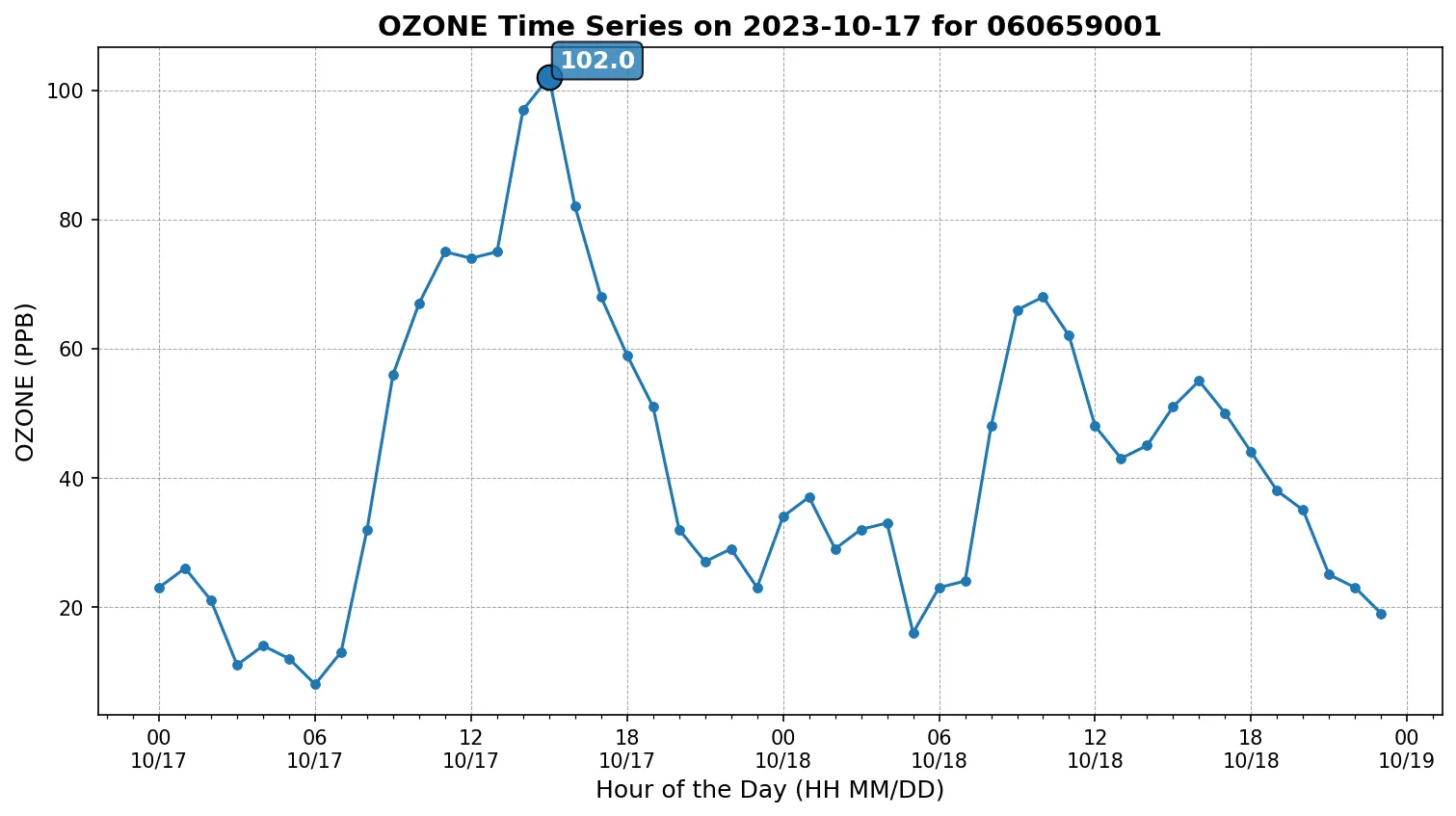
Time series of 1-hour ozone concentrations at Lake Elsinore - W. Flint Street starting on Oct. 17, 2023. The number '1' indicates the highest 1-hour ozone concentration of the day, which is also the time used for HYSPLIT backward trajectory analysis.
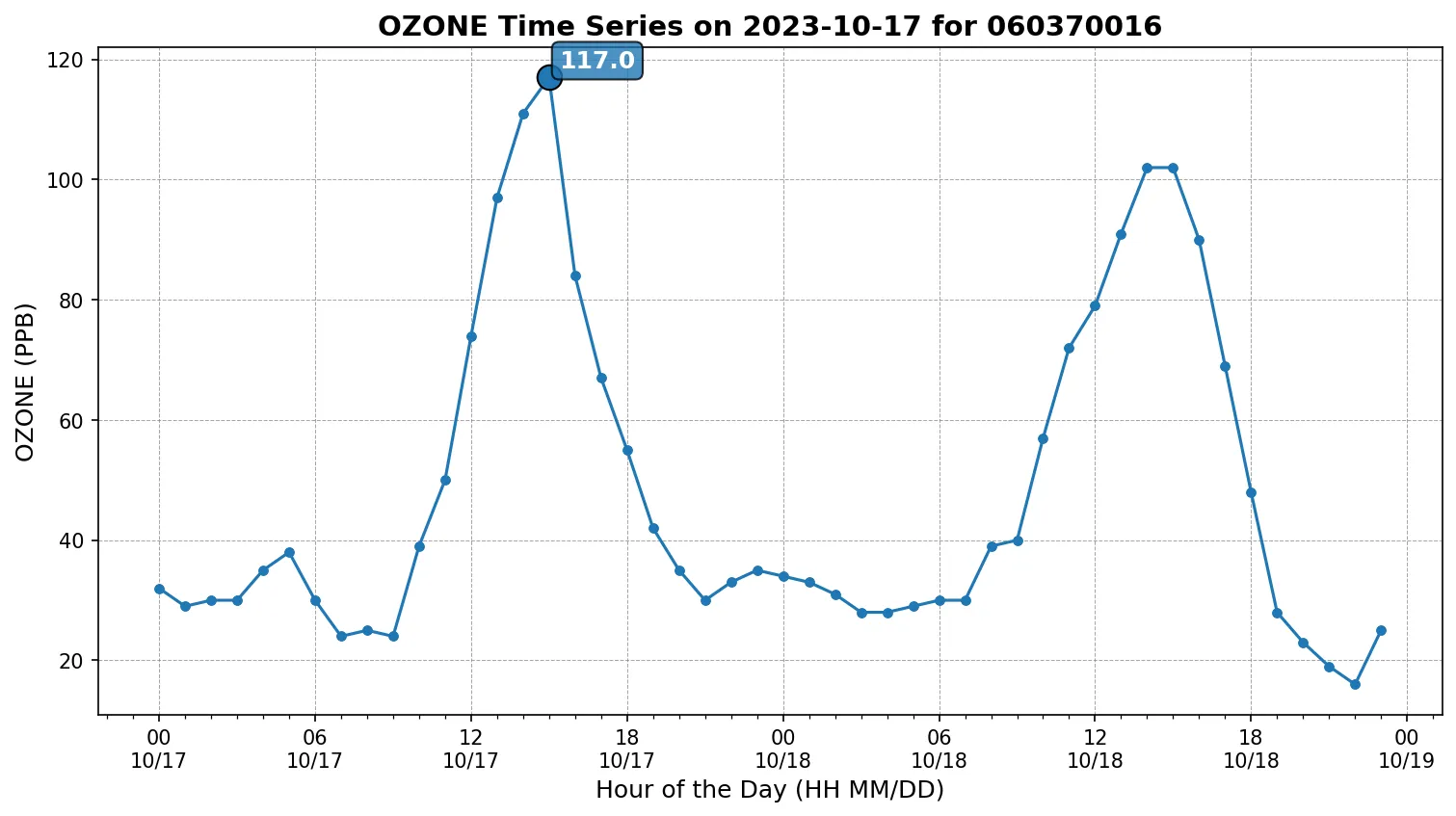
Time series of 1-hour ozone concentrations at Glendora - Laurel starting on Oct. 17, 2023. The number '1' indicates the highest 1-hour ozone concentration of the day, which is also the time used for HYSPLIT backward trajectory analysis.
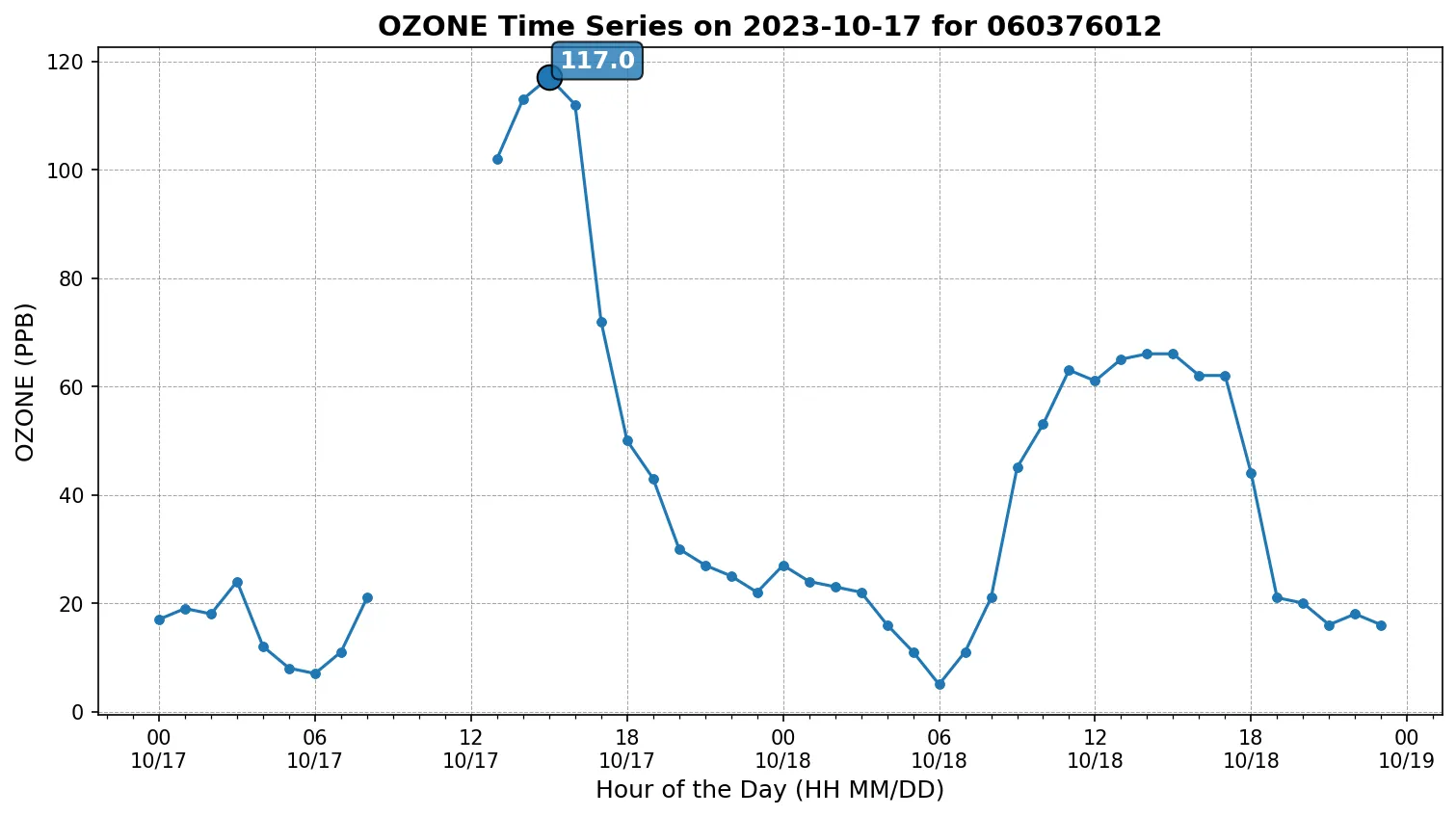
Time series of 1-hour ozone concentrations at Santa Clarita starting on Oct. 17, 2023. The number '1' indicates the highest 1-hour ozone concentration of the day, which is also the time used for HYSPLIT backward trajectory analysis.
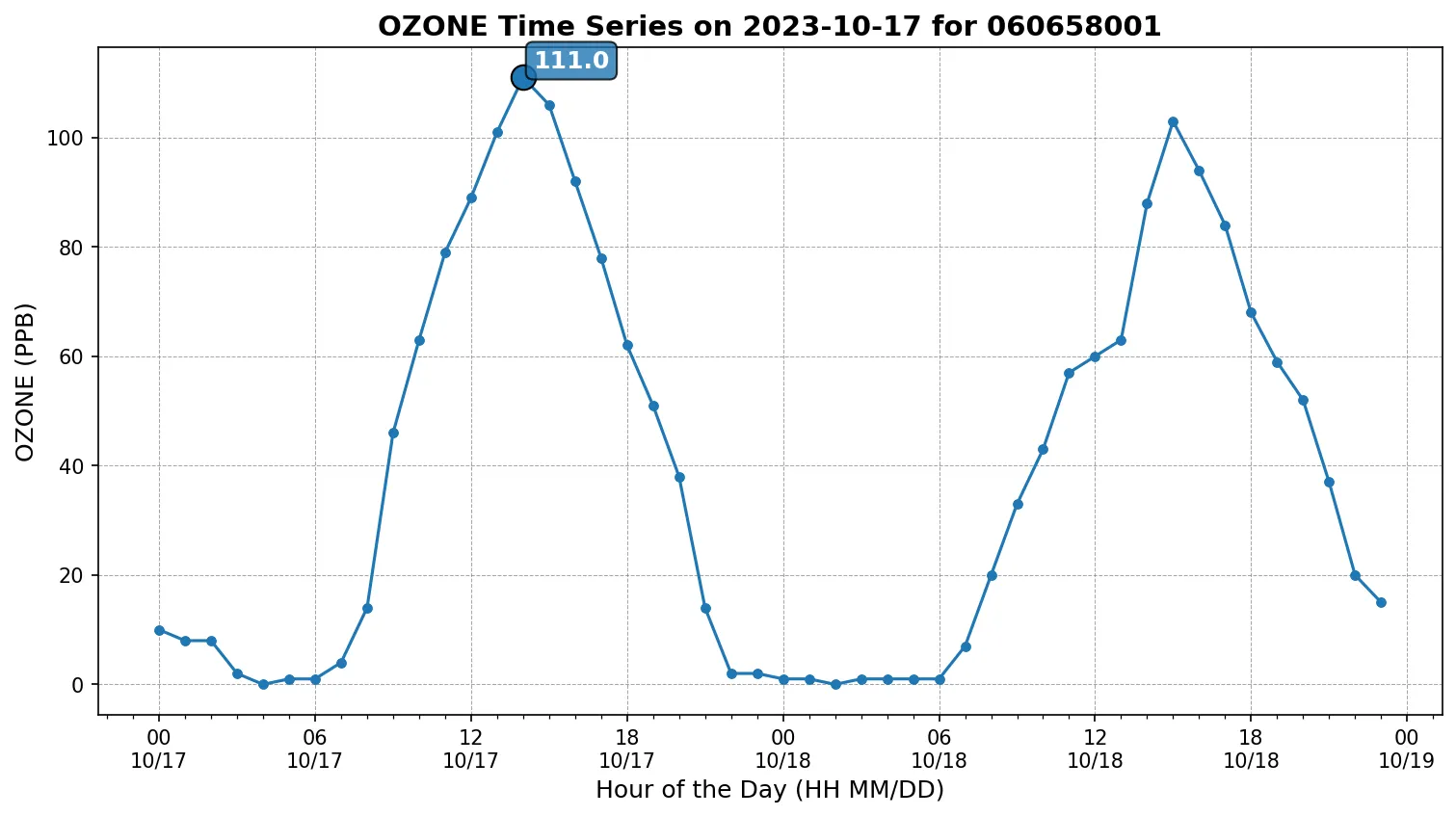
Time series of 1-hour ozone concentrations at Riverside - Rubidoux starting on Oct. 17, 2023. The number '1' indicates the highest 1-hour ozone concentration of the day, which is also the time used for HYSPLIT backward trajectory analysis.
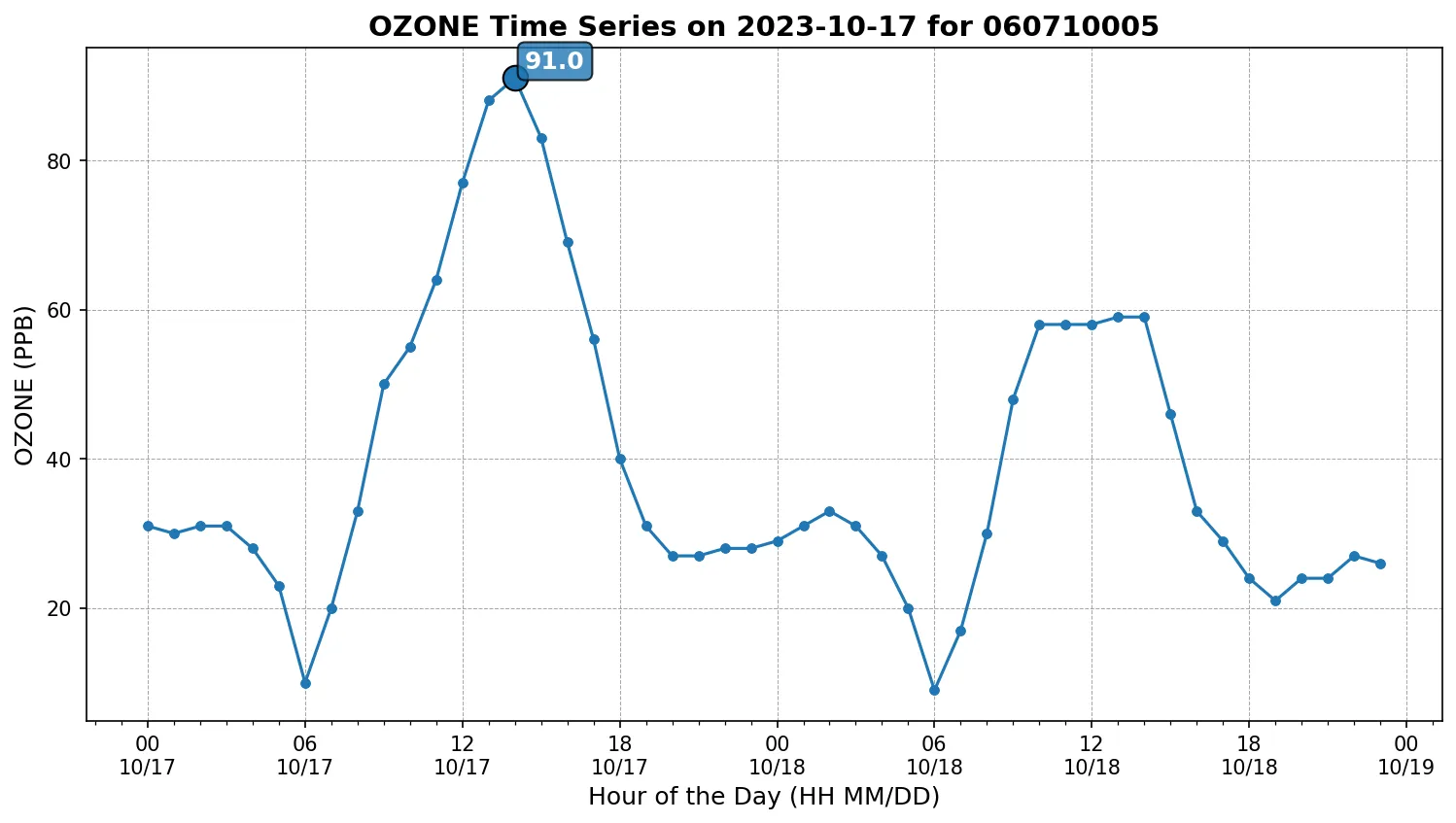
Time series of 1-hour ozone concentrations at Crestline - Lake Gregory starting on Oct. 17, 2023. The number '1' indicates the highest 1-hour ozone concentration of the day, which is also the time used for HYSPLIT backward trajectory analysis.
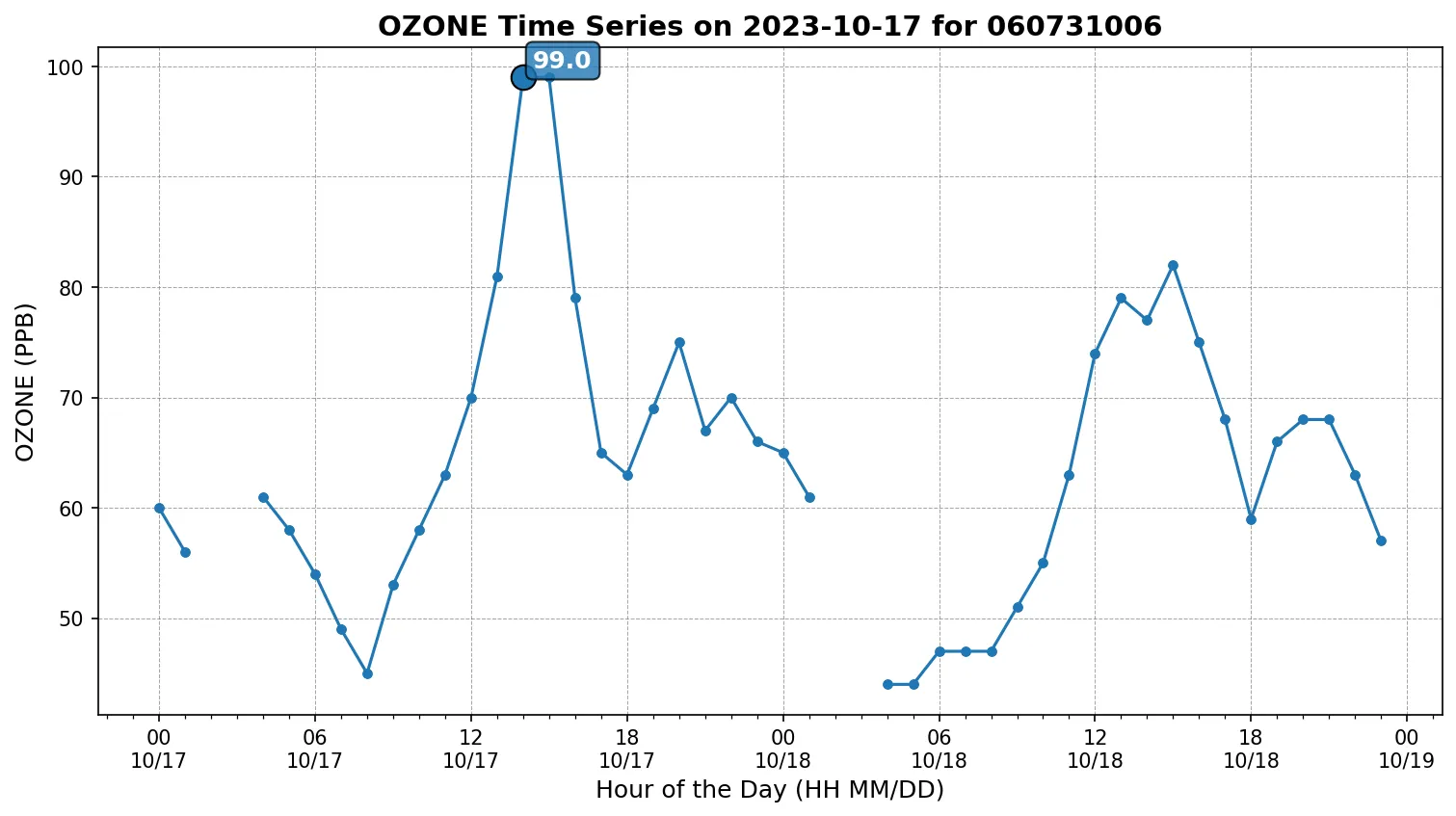
Time series of 1-hour ozone concentrations at Alpine starting on Oct. 17, 2023. The number '1' indicates the highest 1-hour ozone concentration of the day, which is also the time used for HYSPLIT backward trajectory analysis.
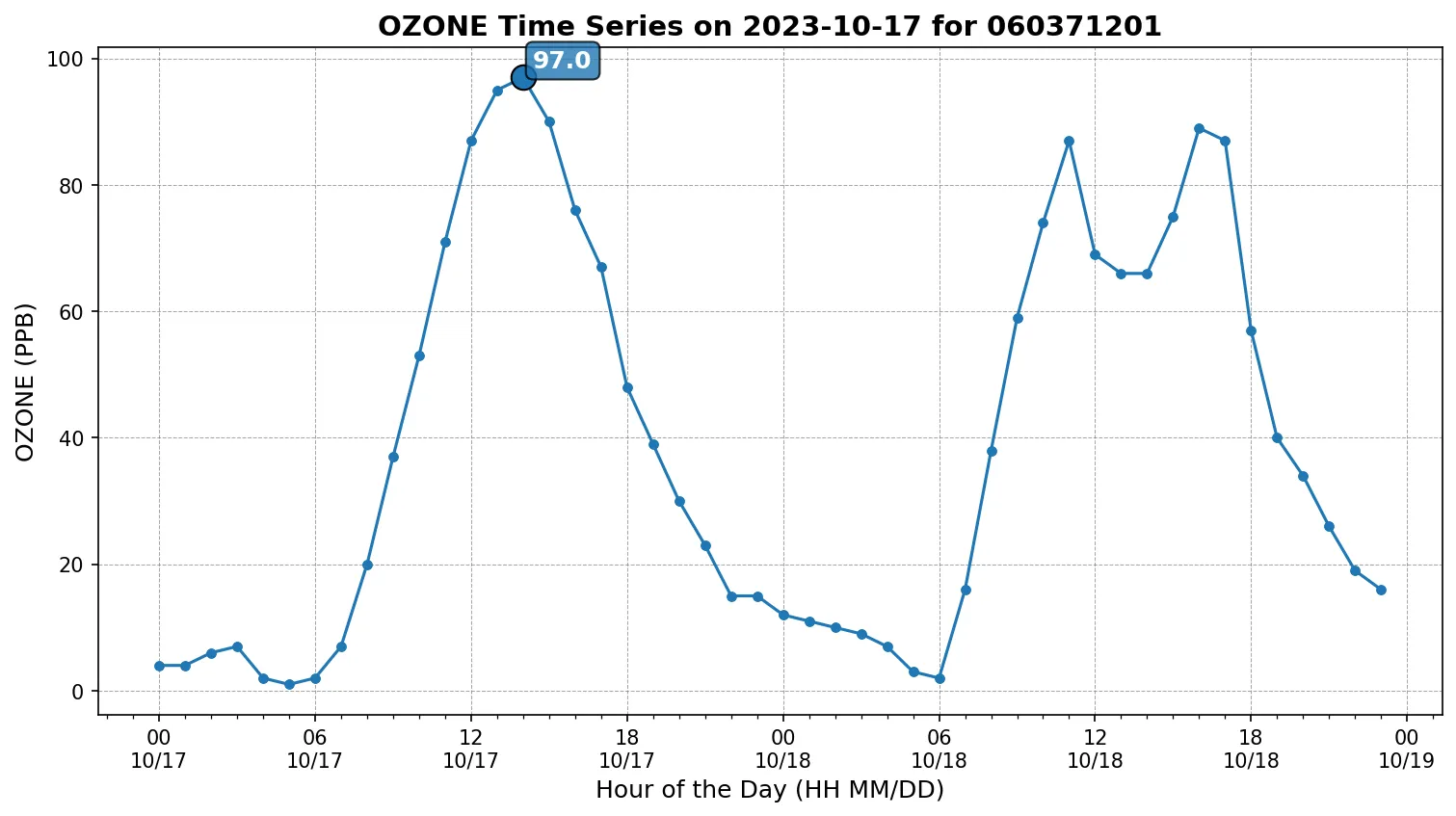
Time series of 1-hour ozone concentrations at Reseda starting on Oct. 17, 2023. The number '1' indicates the highest 1-hour ozone concentration of the day, which is also the time used for HYSPLIT backward trajectory analysis.
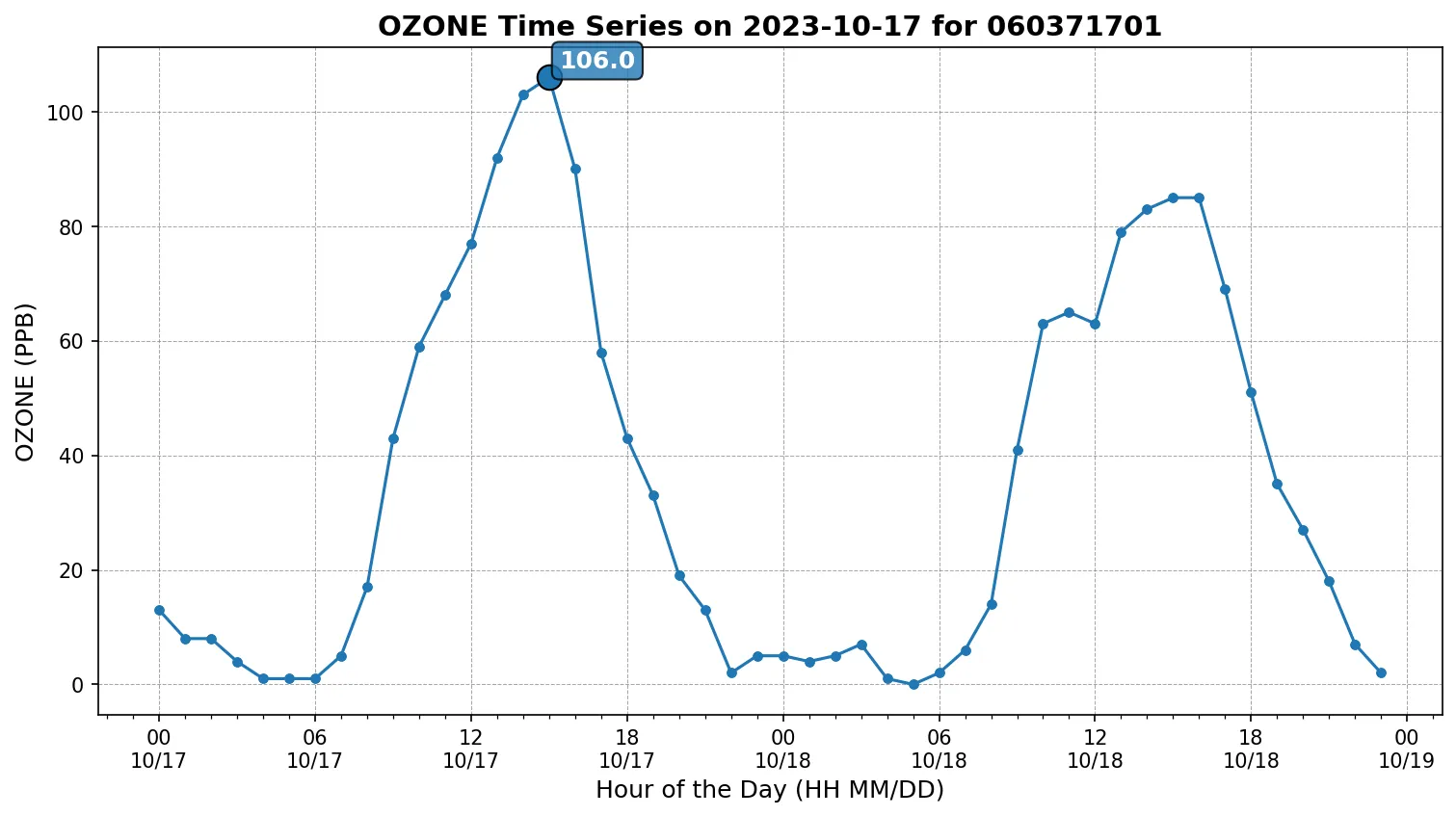
Time series of 1-hour ozone concentrations at Pomona starting on Oct. 17, 2023. The number '1' indicates the highest 1-hour ozone concentration of the day, which is also the time used for HYSPLIT backward trajectory analysis.
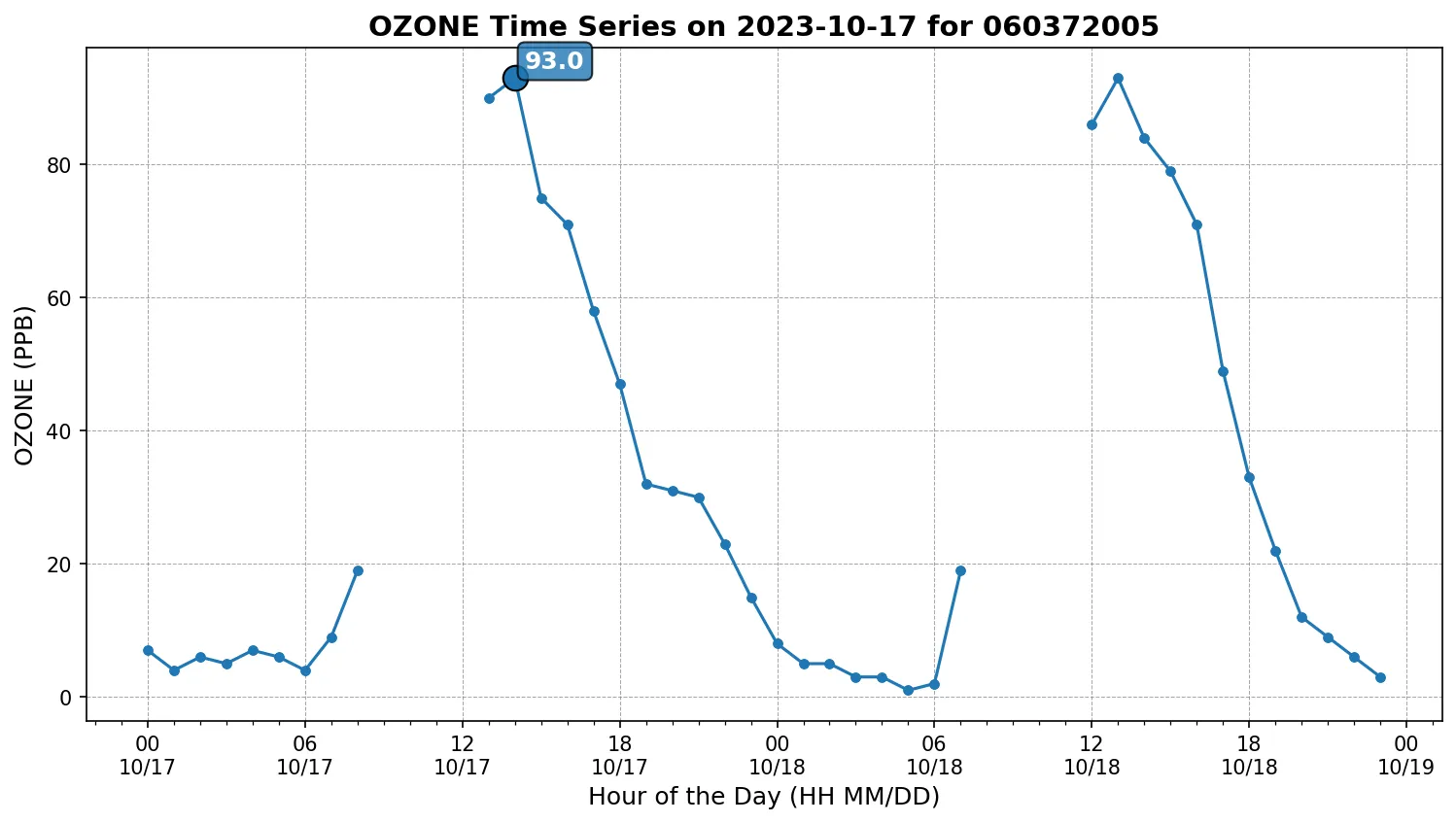
Time series of 1-hour ozone concentrations at Pasadena starting on Oct. 17, 2023. The number '1' indicates the highest 1-hour ozone concentration of the day, which is also the time used for HYSPLIT backward trajectory analysis.
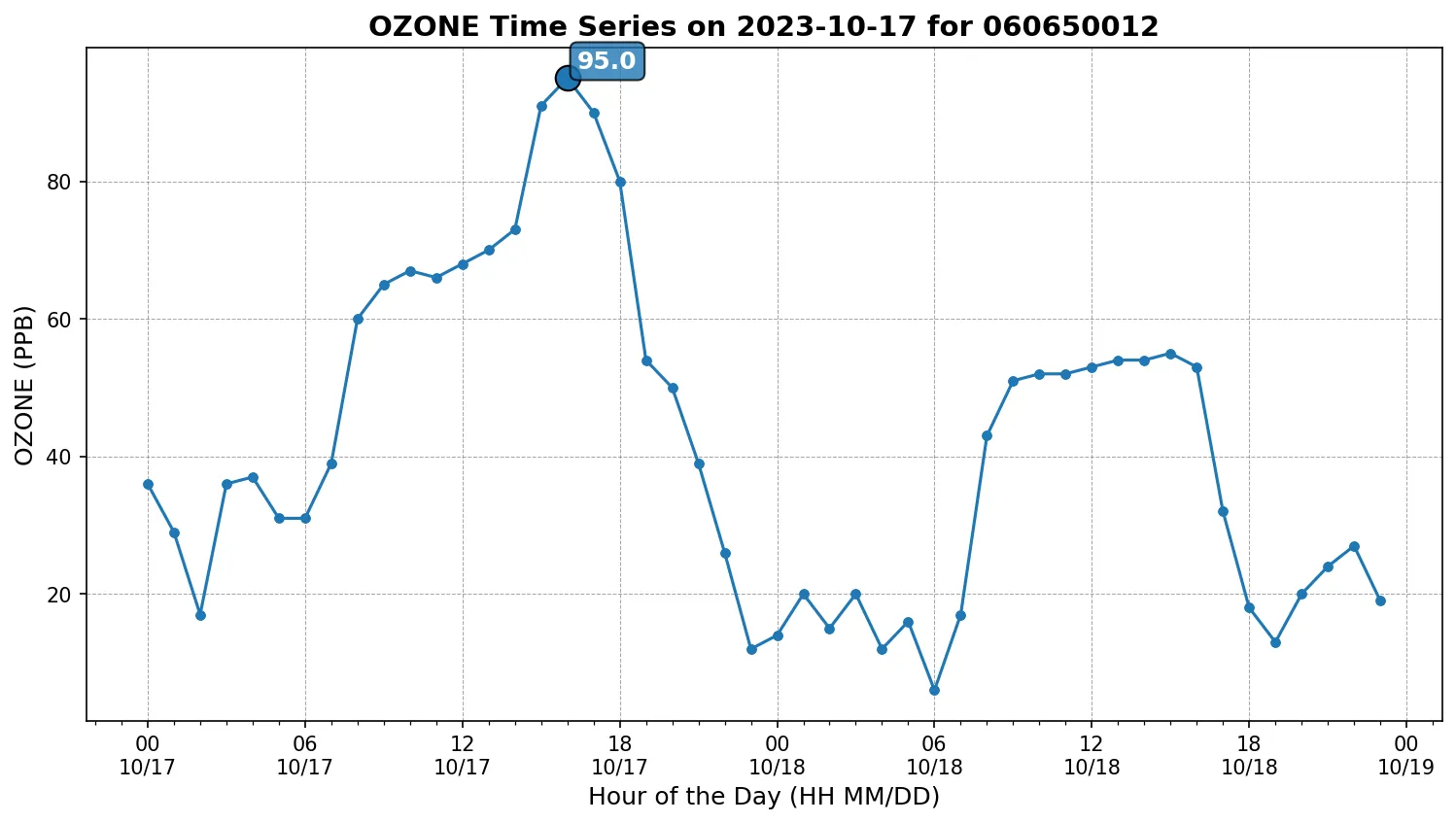
Time series of 1-hour ozone concentrations at Banning - South Hathaway Street starting on Oct. 17, 2023. The number '1' indicates the highest 1-hour ozone concentration of the day, which is also the time used for HYSPLIT backward trajectory analysis.
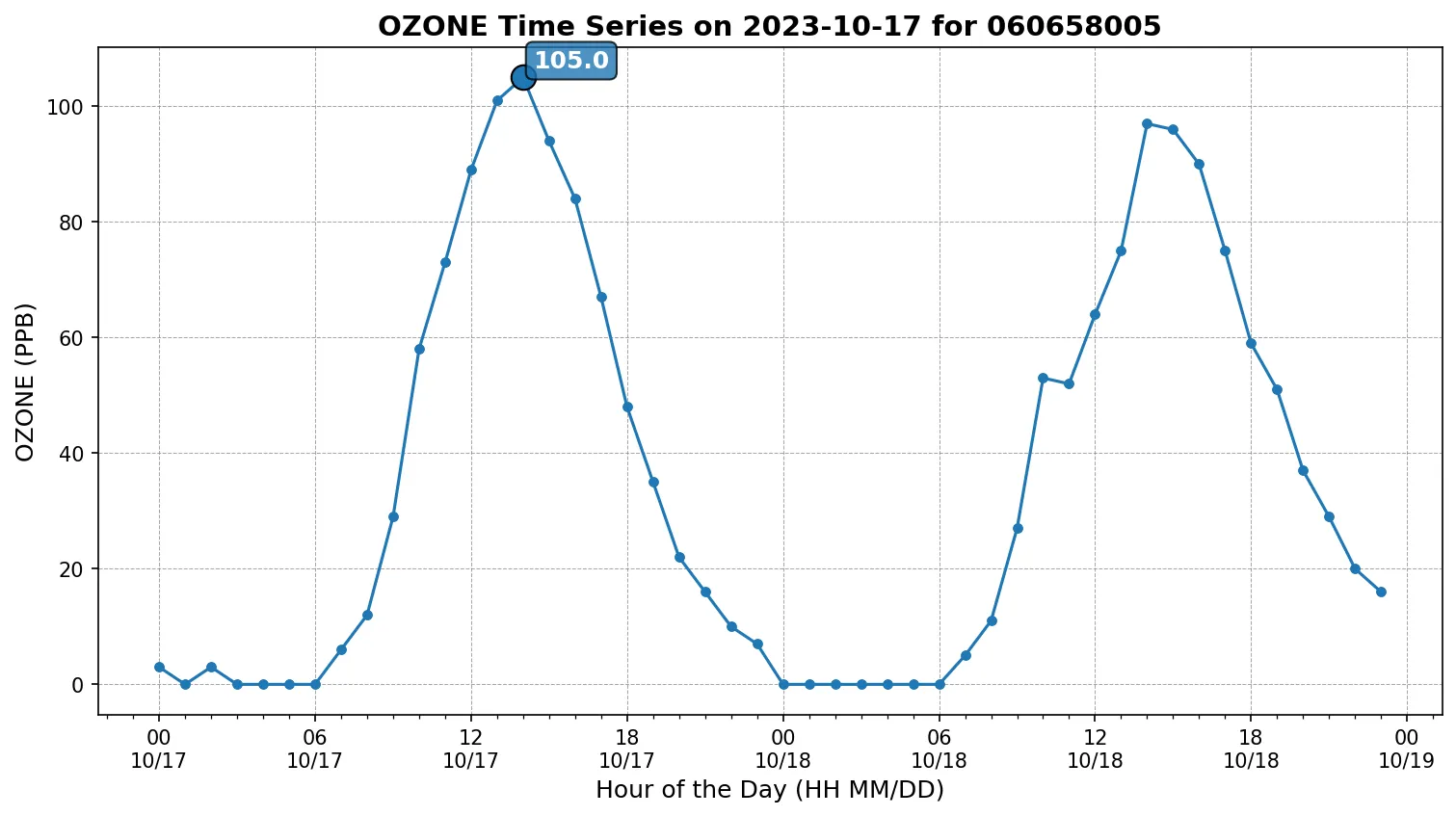
Time series of 1-hour ozone concentrations at Mira Loma - Van Buren starting on Oct. 17, 2023. The number '1' indicates the highest 1-hour ozone concentration of the day, which is also the time used for HYSPLIT backward trajectory analysis.
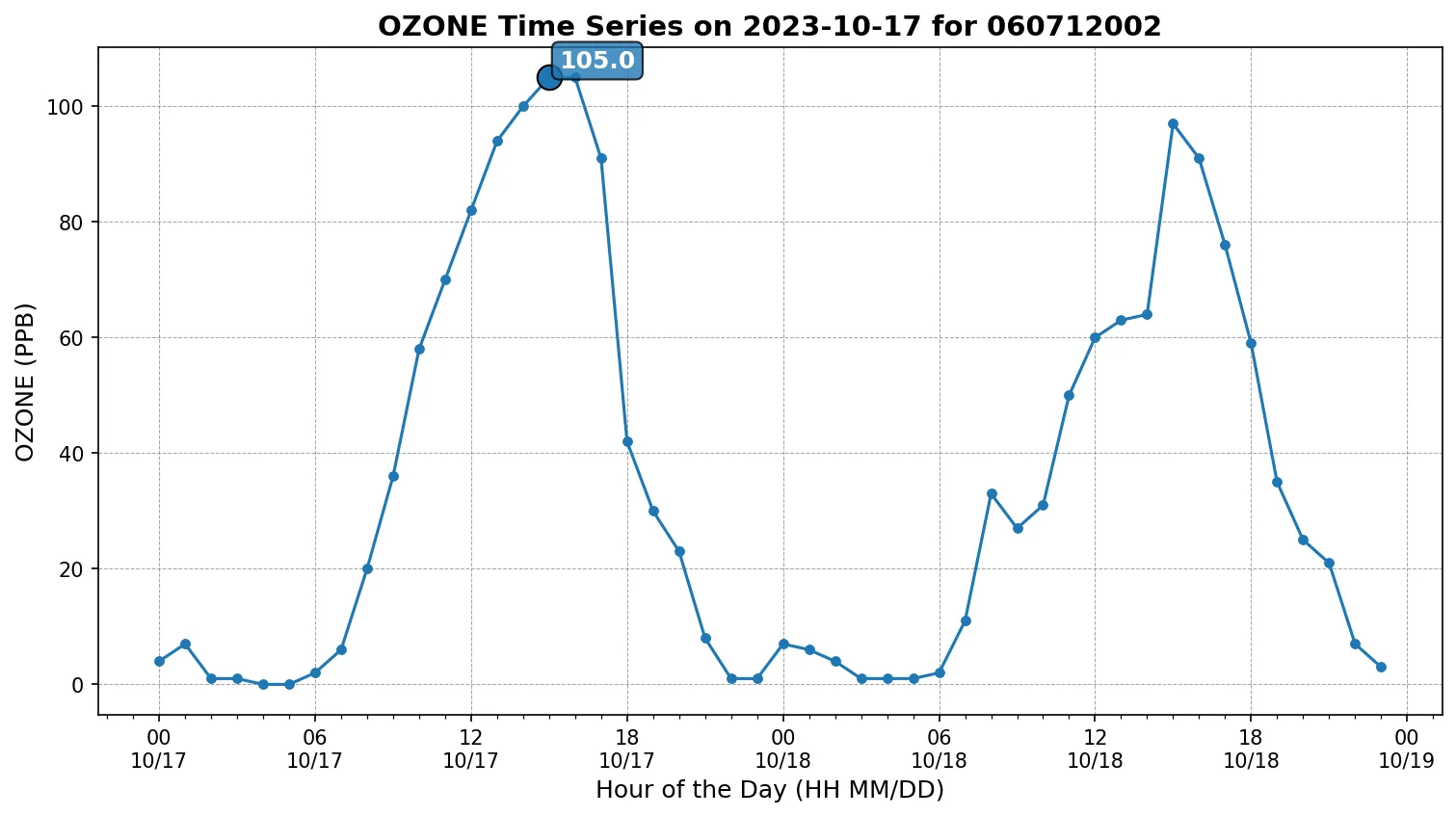
Time series of 1-hour ozone concentrations at Fontana - Arrow Highway starting on Oct. 17, 2023. The number '1' indicates the highest 1-hour ozone concentration of the day, which is also the time used for HYSPLIT backward trajectory analysis.
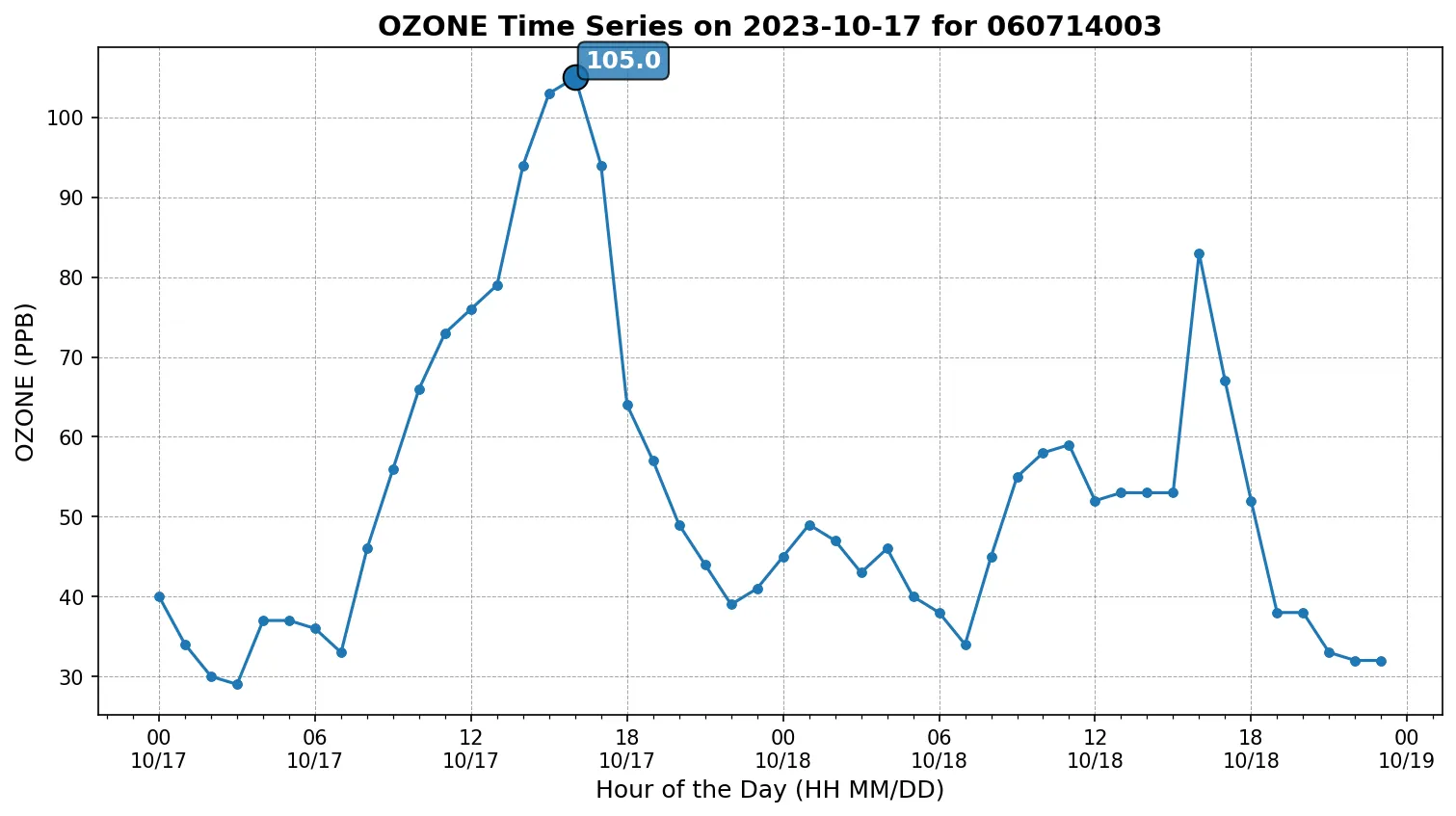
Time series of 1-hour ozone concentrations at Redlands - Dearborn starting on Oct. 17, 2023. The number '1' indicates the highest 1-hour ozone concentration of the day, which is also the time used for HYSPLIT backward trajectory analysis.
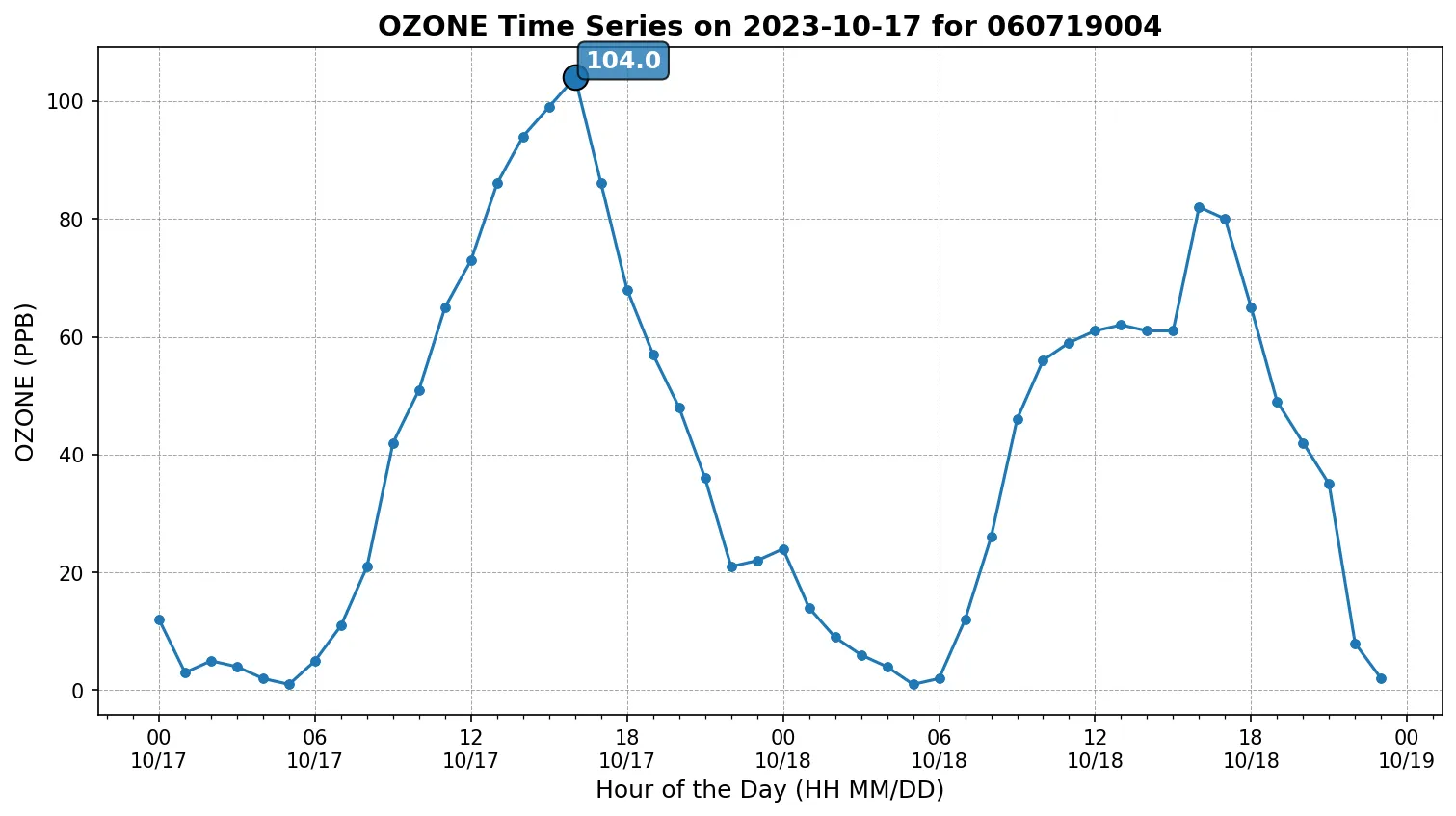
Time series of 1-hour ozone concentrations at San Bernadino - 4th Street starting on Oct. 17, 2023. The number '1' indicates the highest 1-hour ozone concentration of the day, which is also the time used for HYSPLIT backward trajectory analysis.
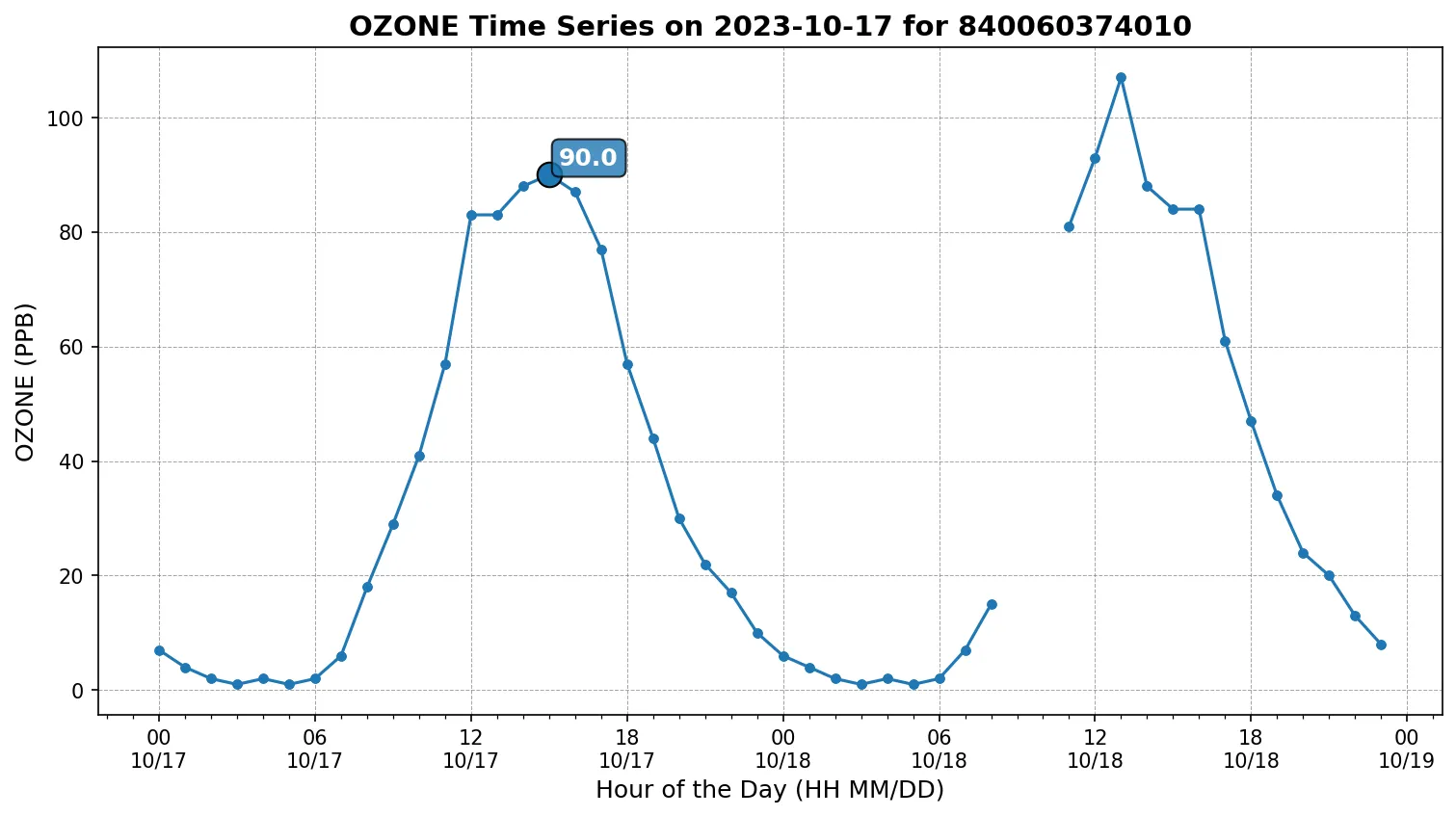
Time series of 1-hour ozone concentrations at North Holywood starting on Oct. 17, 2023. The number '1' indicates the highest 1-hour ozone concentration of the day, which is also the time used for HYSPLIT backward trajectory analysis.
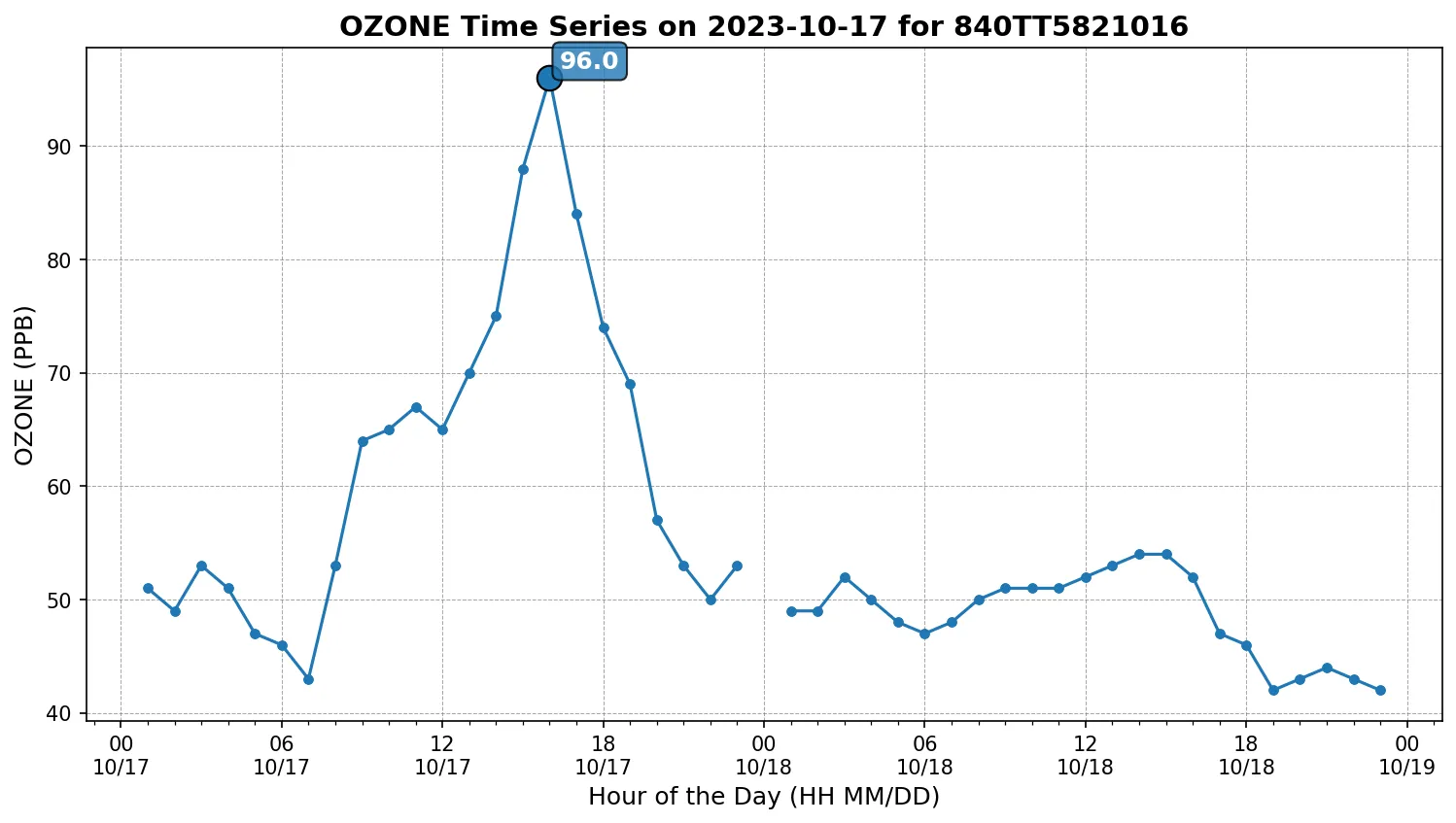
Time series of 1-hour ozone concentrations at Morongo School starting on Oct. 17, 2023. The number '1' indicates the highest 1-hour ozone concentration of the day, which is also the time used for HYSPLIT backward trajectory analysis.
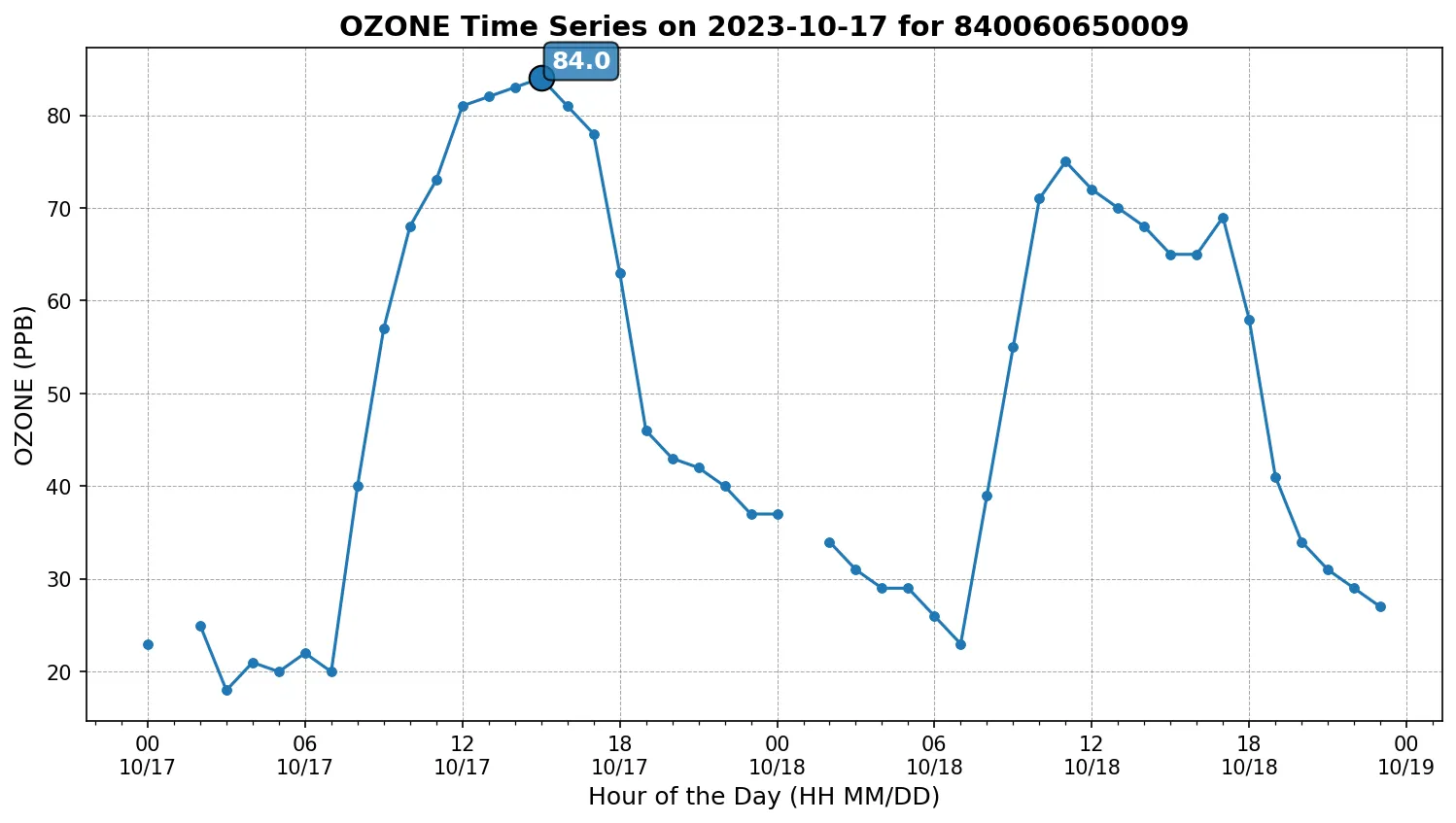
Time series of 1-hour ozone concentrations at Pechanga Reservation starting on Oct. 17, 2023. The number '1' indicates the highest 1-hour ozone concentration of the day, which is also the time used for HYSPLIT backward trajectory analysis.
Historical Daily Maximum 8-Hour Ozone Concentration
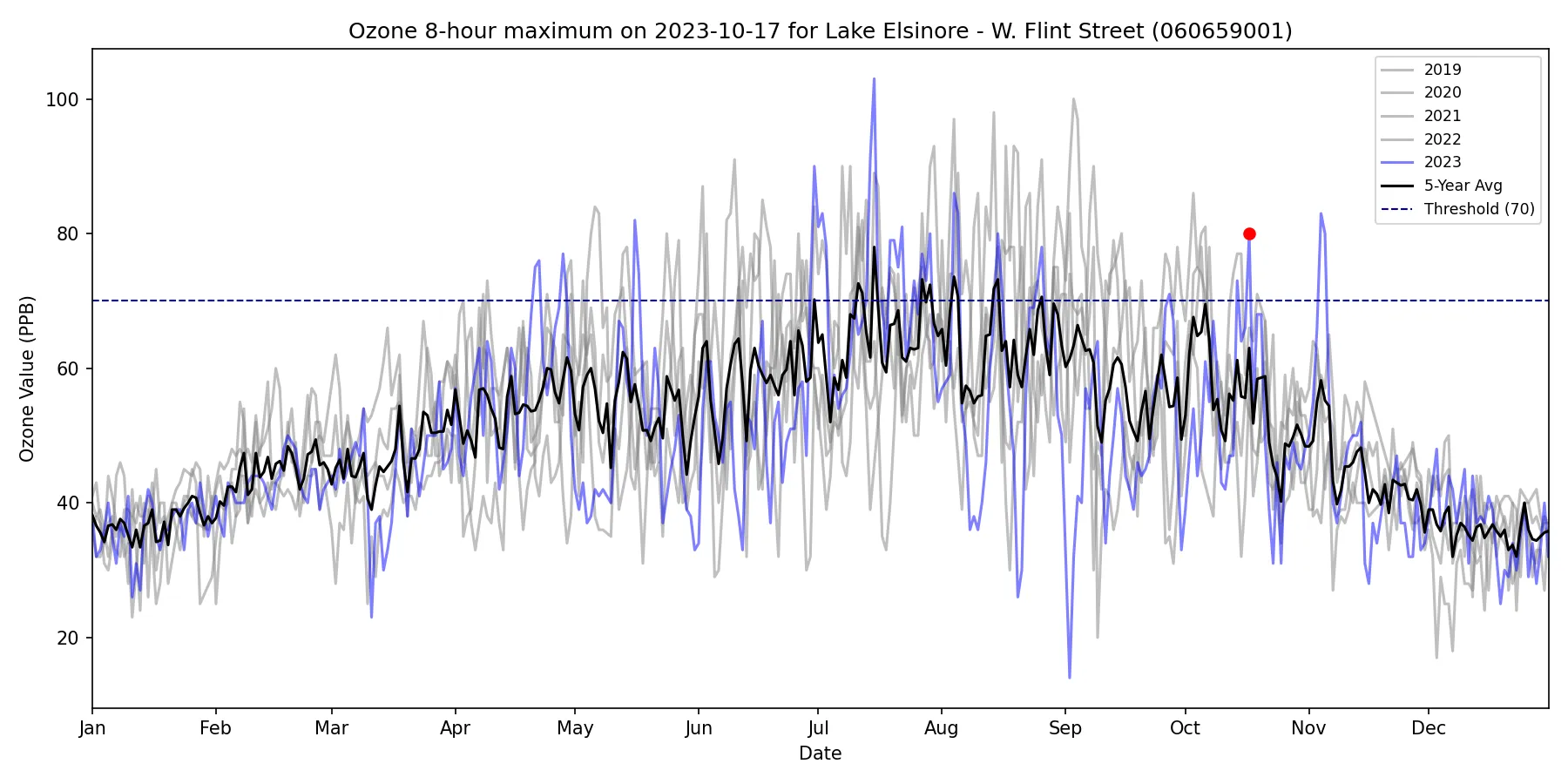
Time series plot of daily maximum 8-Hour ozone concentrations at Lake Elsinore - W. Flint Street for each year between 2019 and 2023. The colored dots represent the daily maximum 8-Hour ozone concentrations on Oct. 17, 2023. The black line indicates the 5-year average daily maximum 8-Hour ozone concentration, and the grey dashed line represents the 70 ppb daily ozone standard.
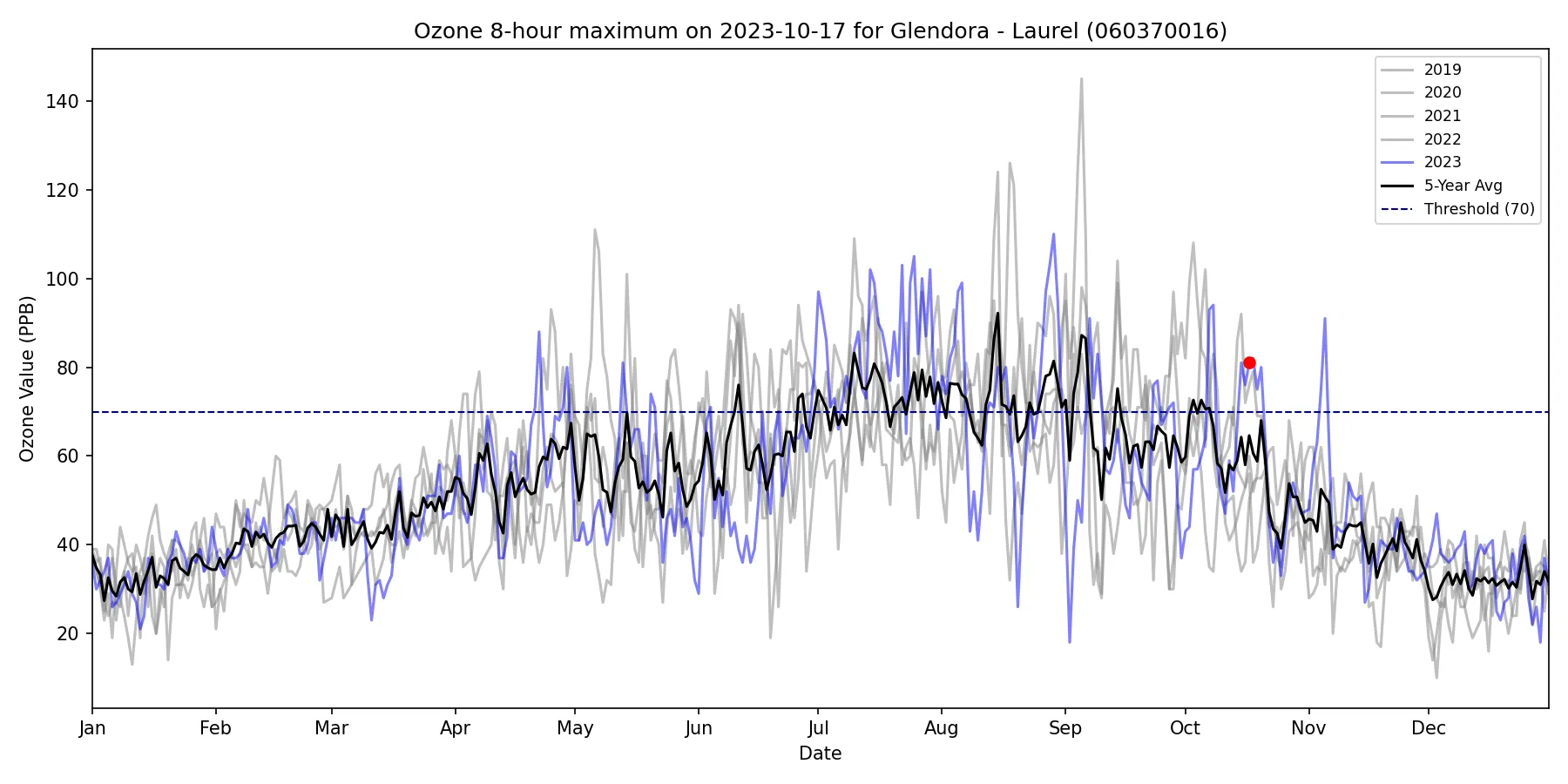
Time series plot of daily maximum 8-Hour ozone concentrations at Glendora - Laurel for each year between 2019 and 2023. The colored dots represent the daily maximum 8-Hour ozone concentrations on Oct. 17, 2023. The black line indicates the 5-year average daily maximum 8-Hour ozone concentration, and the grey dashed line represents the 70 ppb daily ozone standard.
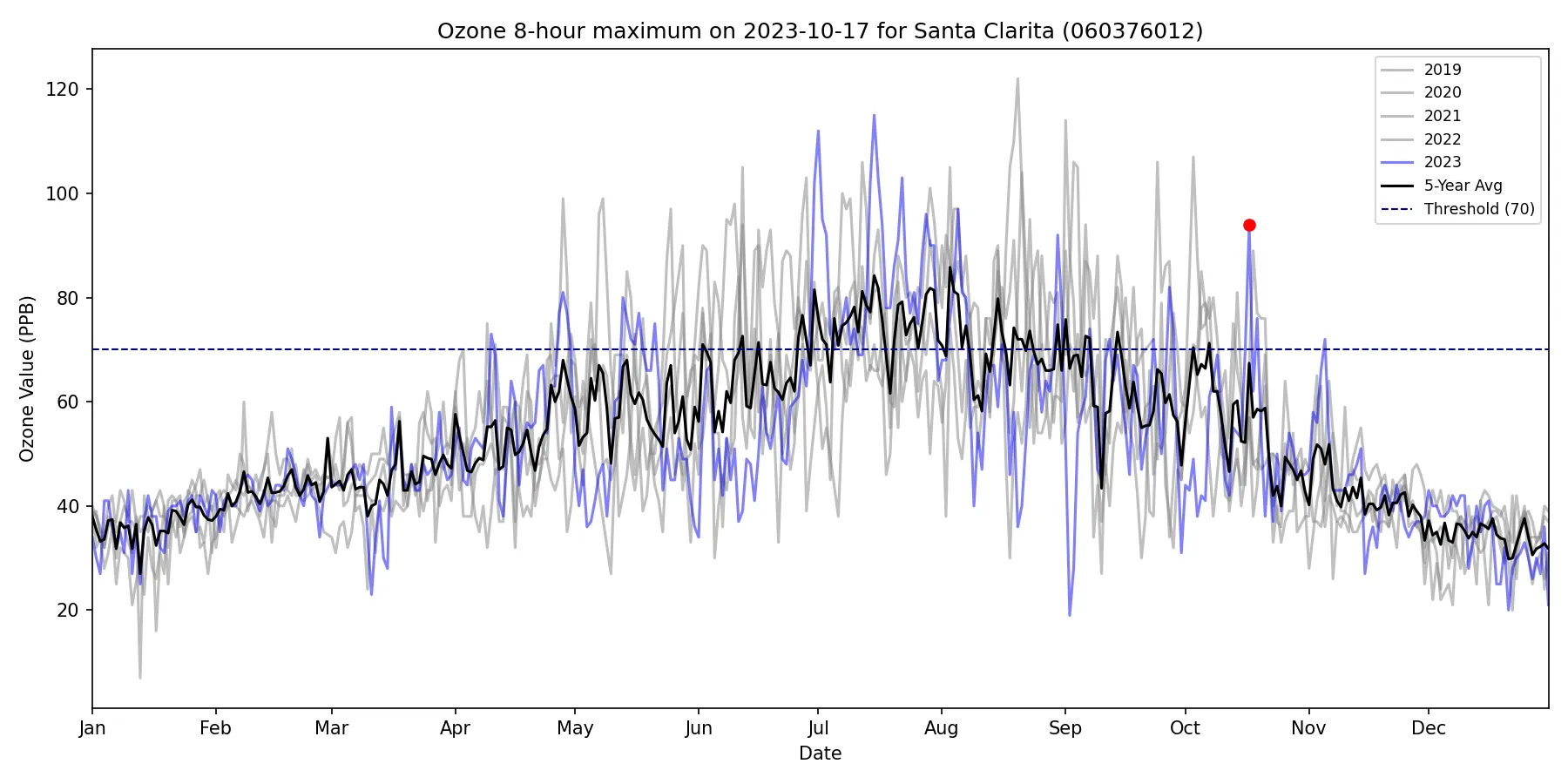
Time series plot of daily maximum 8-Hour ozone concentrations at Santa Clarita for each year between 2019 and 2023. The colored dots represent the daily maximum 8-Hour ozone concentrations on Oct. 17, 2023. The black line indicates the 5-year average daily maximum 8-Hour ozone concentration, and the grey dashed line represents the 70 ppb daily ozone standard.
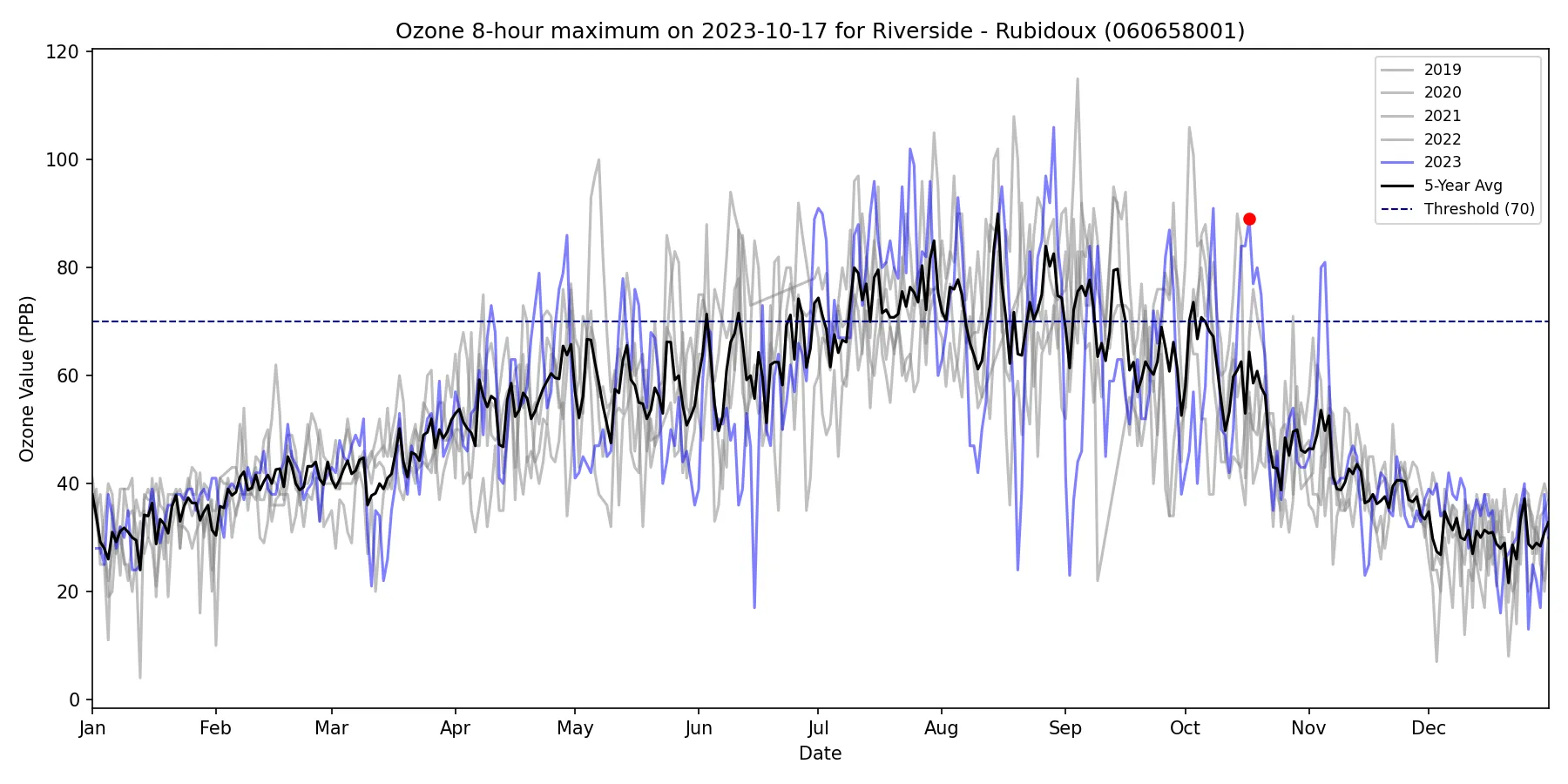
Time series plot of daily maximum 8-Hour ozone concentrations at Riverside - Rubidoux for each year between 2019 and 2023. The colored dots represent the daily maximum 8-Hour ozone concentrations on Oct. 17, 2023. The black line indicates the 5-year average daily maximum 8-Hour ozone concentration, and the grey dashed line represents the 70 ppb daily ozone standard.
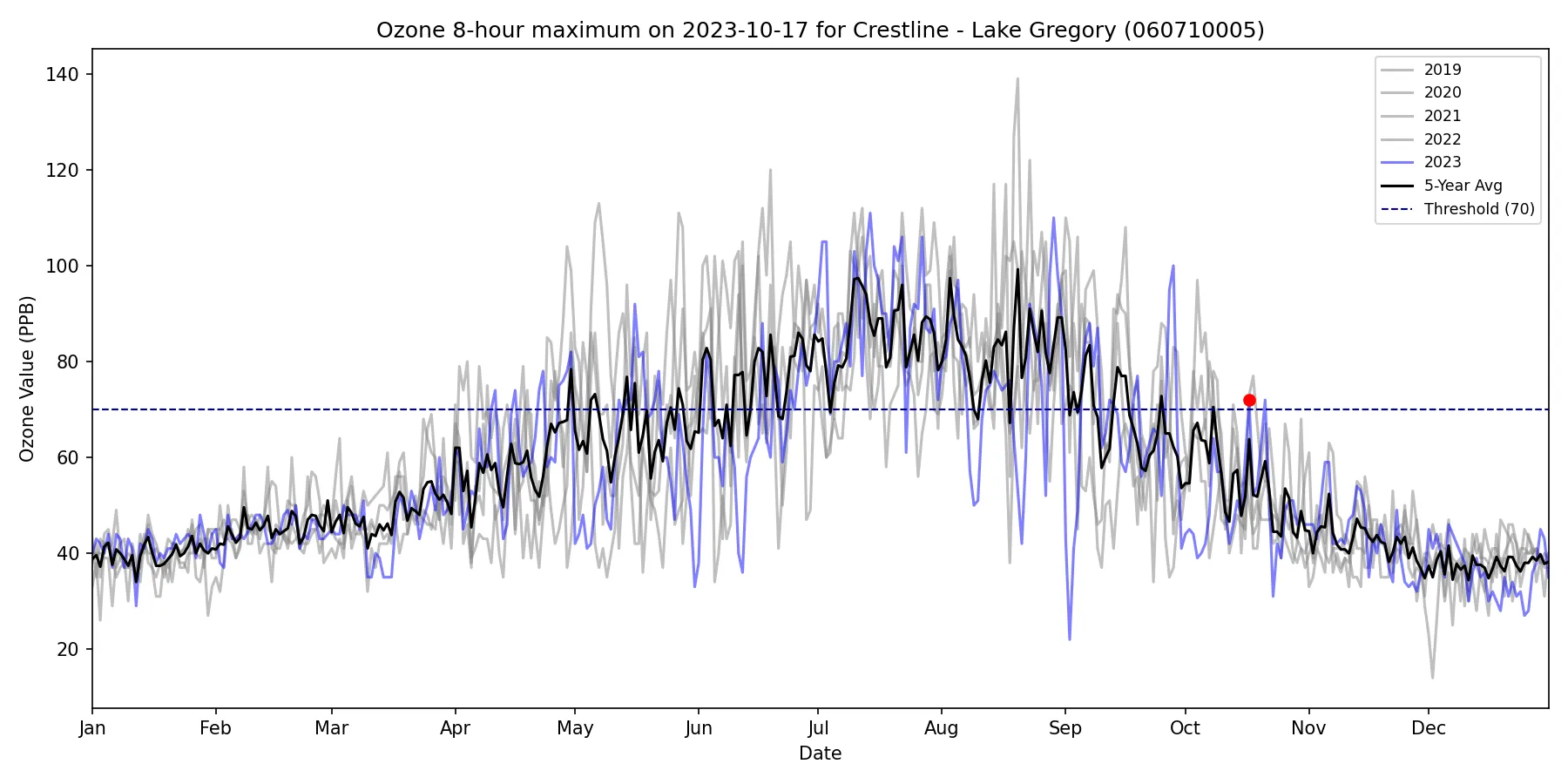
Time series plot of daily maximum 8-Hour ozone concentrations at Crestline - Lake Gregory for each year between 2019 and 2023. The colored dots represent the daily maximum 8-Hour ozone concentrations on Oct. 17, 2023. The black line indicates the 5-year average daily maximum 8-Hour ozone concentration, and the grey dashed line represents the 70 ppb daily ozone standard.
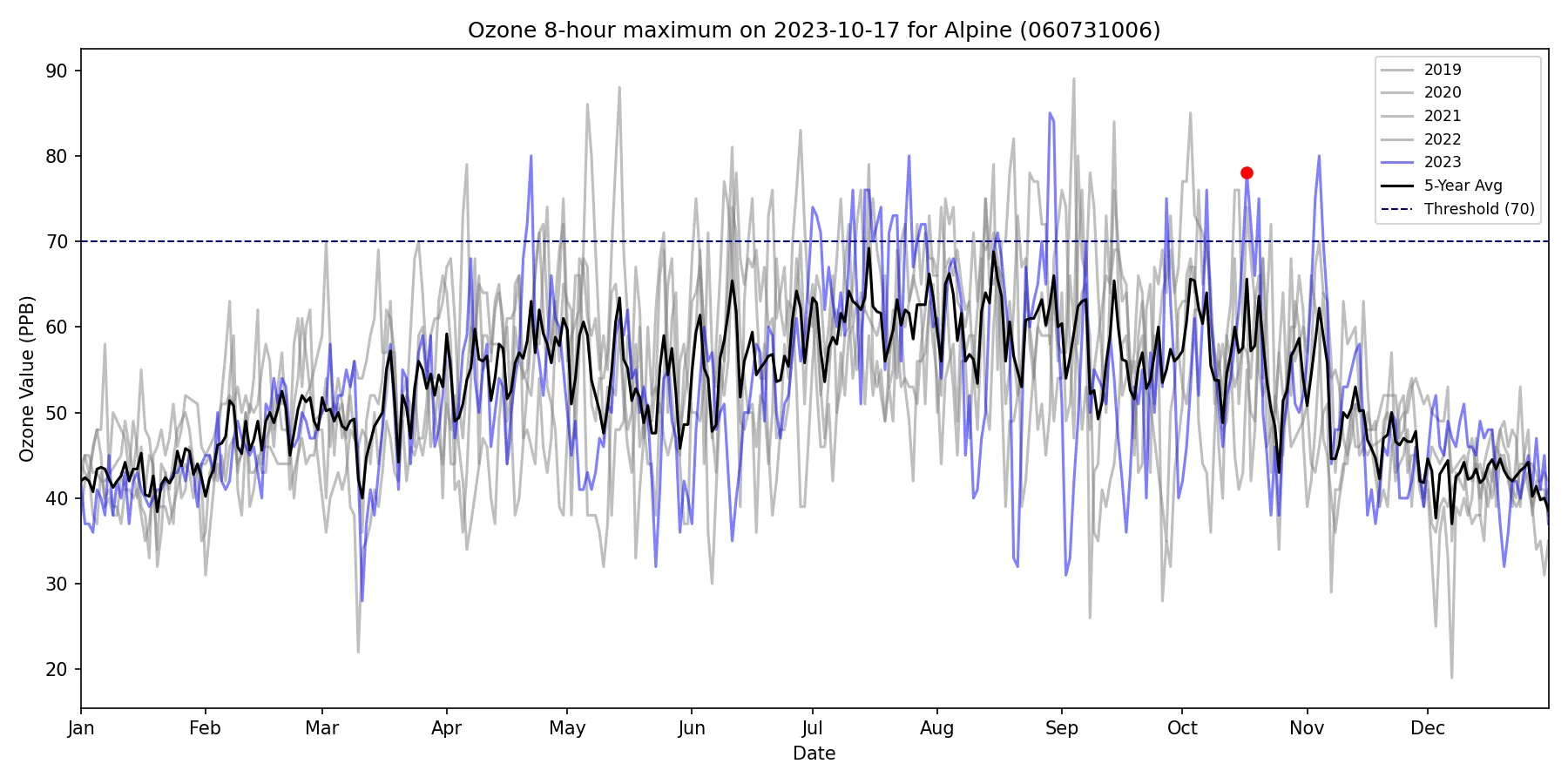
Time series plot of daily maximum 8-Hour ozone concentrations at Alpine for each year between 2019 and 2023. The colored dots represent the daily maximum 8-Hour ozone concentrations on Oct. 17, 2023. The black line indicates the 5-year average daily maximum 8-Hour ozone concentration, and the grey dashed line represents the 70 ppb daily ozone standard.
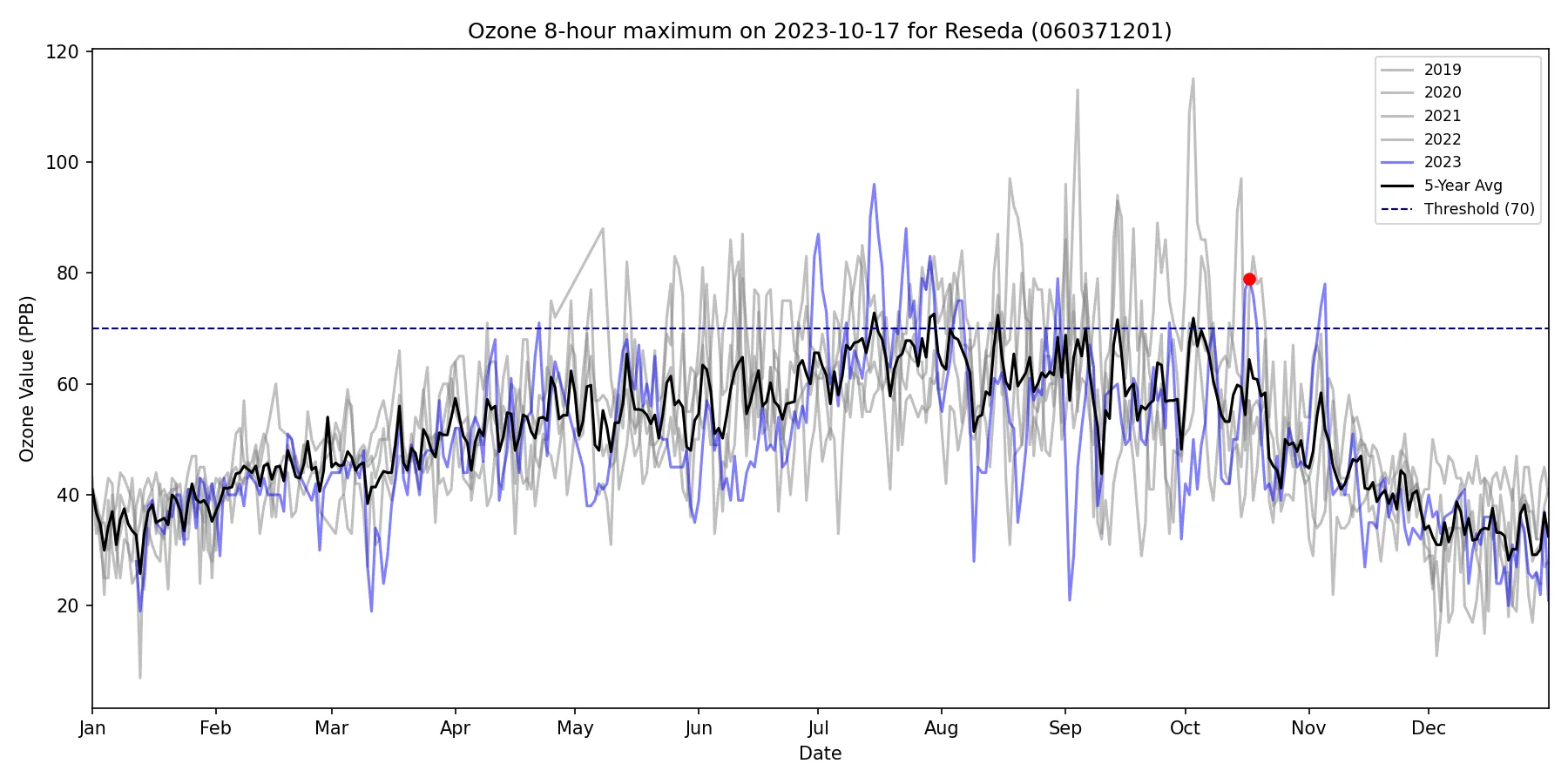
Time series plot of daily maximum 8-Hour ozone concentrations at Reseda for each year between 2019 and 2023. The colored dots represent the daily maximum 8-Hour ozone concentrations on Oct. 17, 2023. The black line indicates the 5-year average daily maximum 8-Hour ozone concentration, and the grey dashed line represents the 70 ppb daily ozone standard.
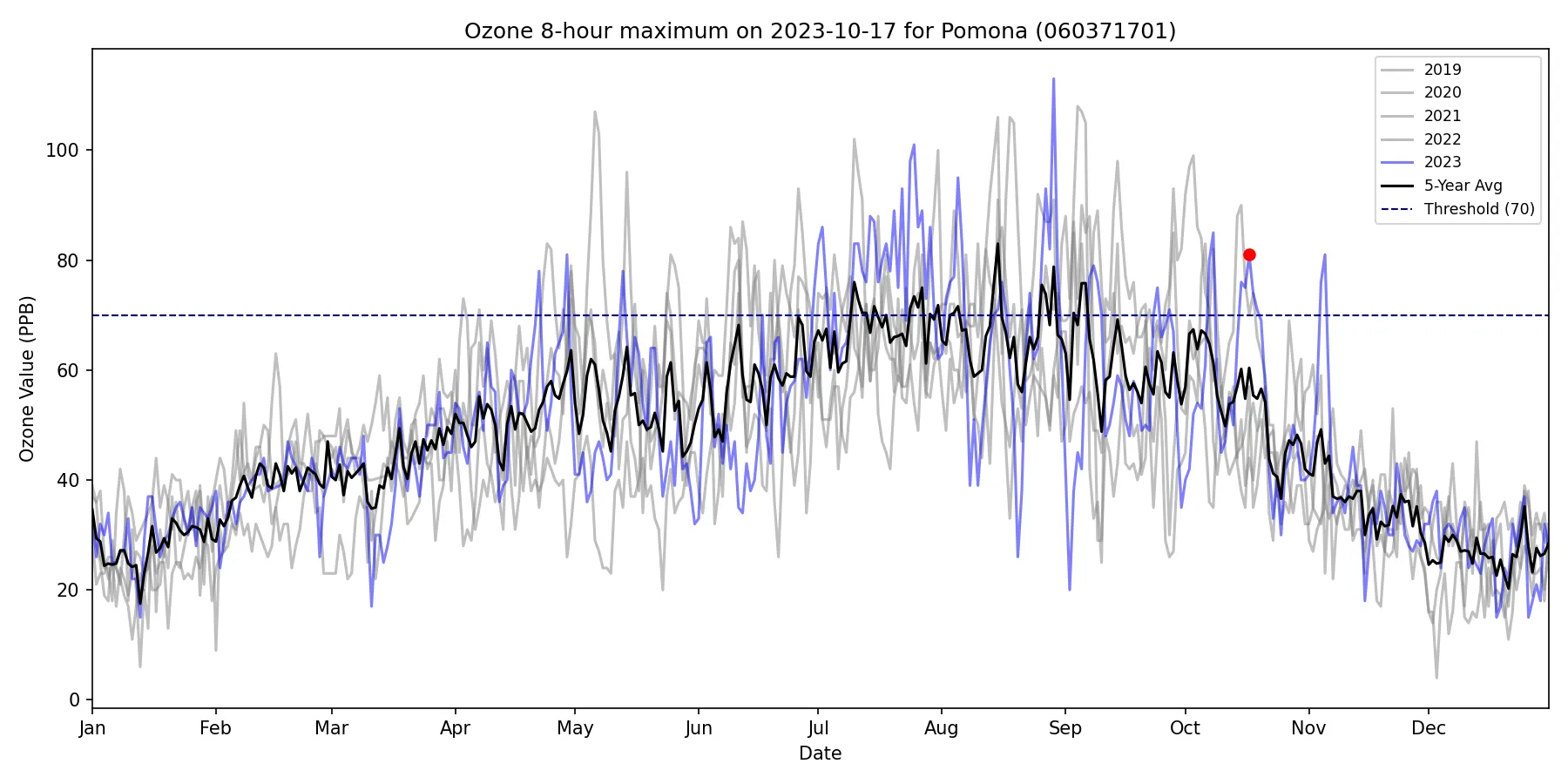
Time series plot of daily maximum 8-Hour ozone concentrations at Pomona for each year between 2019 and 2023. The colored dots represent the daily maximum 8-Hour ozone concentrations on Oct. 17, 2023. The black line indicates the 5-year average daily maximum 8-Hour ozone concentration, and the grey dashed line represents the 70 ppb daily ozone standard.
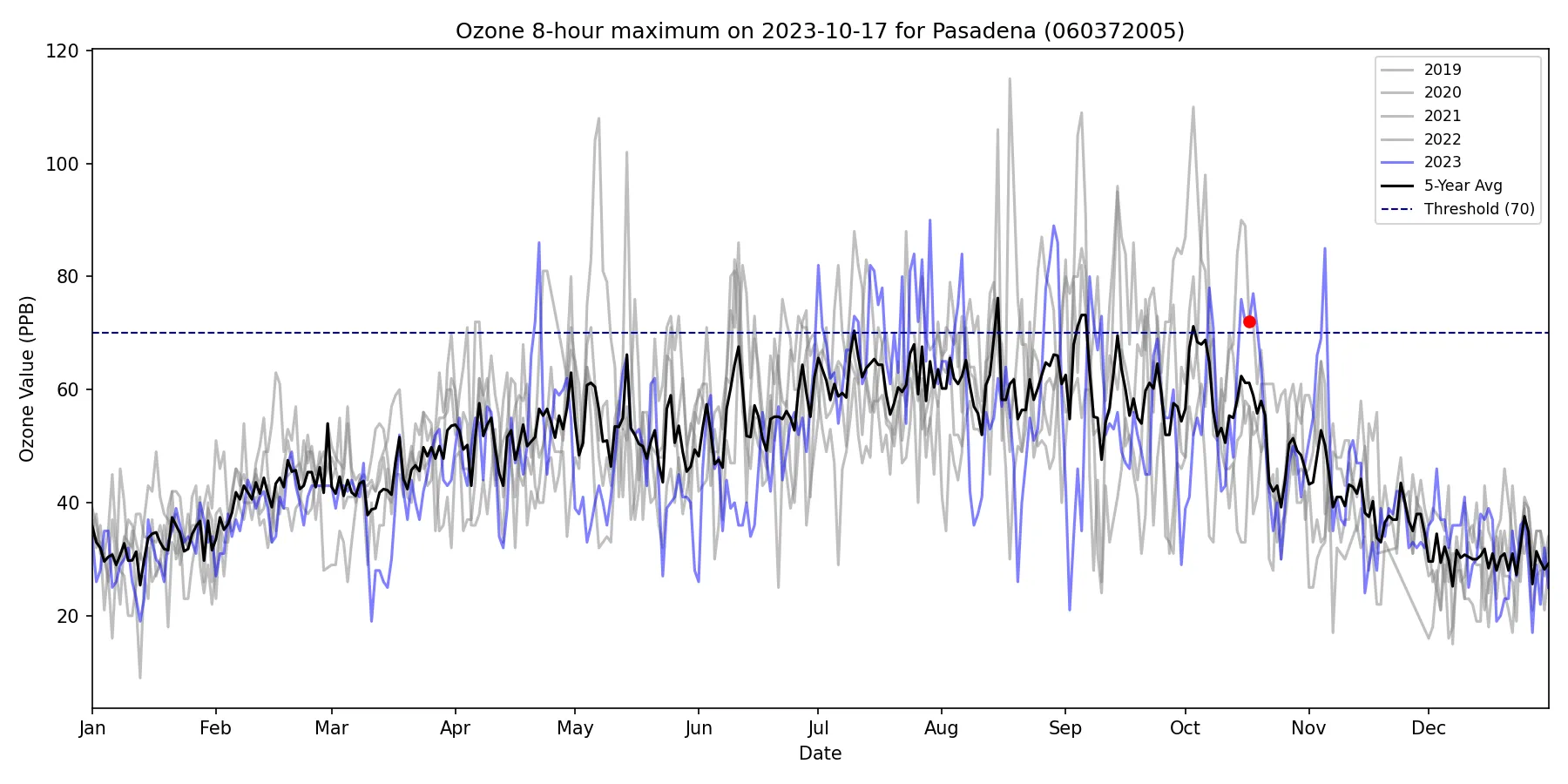
Time series plot of daily maximum 8-Hour ozone concentrations at Pasadena for each year between 2019 and 2023. The colored dots represent the daily maximum 8-Hour ozone concentrations on Oct. 17, 2023. The black line indicates the 5-year average daily maximum 8-Hour ozone concentration, and the grey dashed line represents the 70 ppb daily ozone standard.
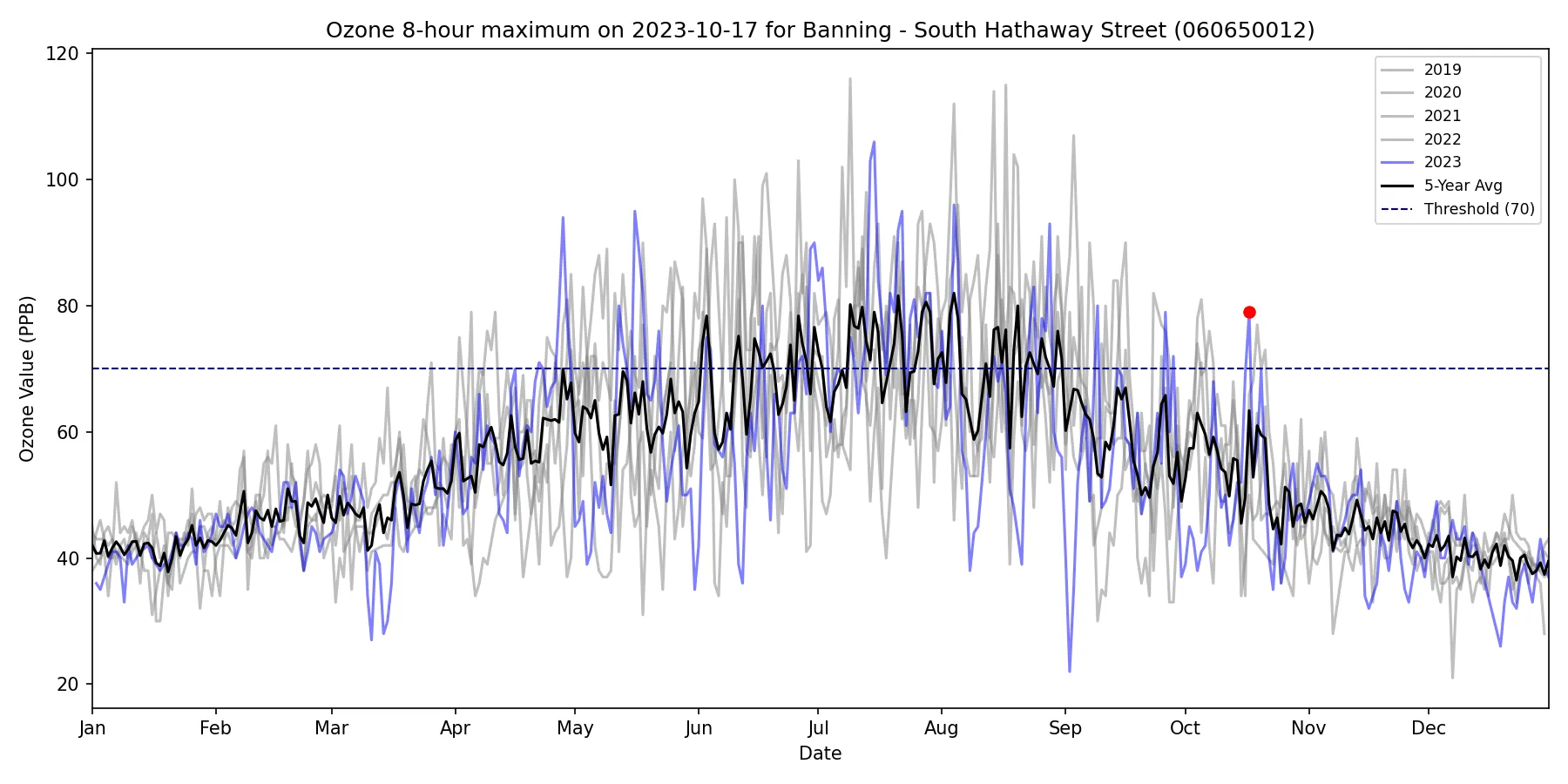
Time series plot of daily maximum 8-Hour ozone concentrations at Banning - South Hathaway Street for each year between 2019 and 2023. The colored dots represent the daily maximum 8-Hour ozone concentrations on Oct. 17, 2023. The black line indicates the 5-year average daily maximum 8-Hour ozone concentration, and the grey dashed line represents the 70 ppb daily ozone standard.
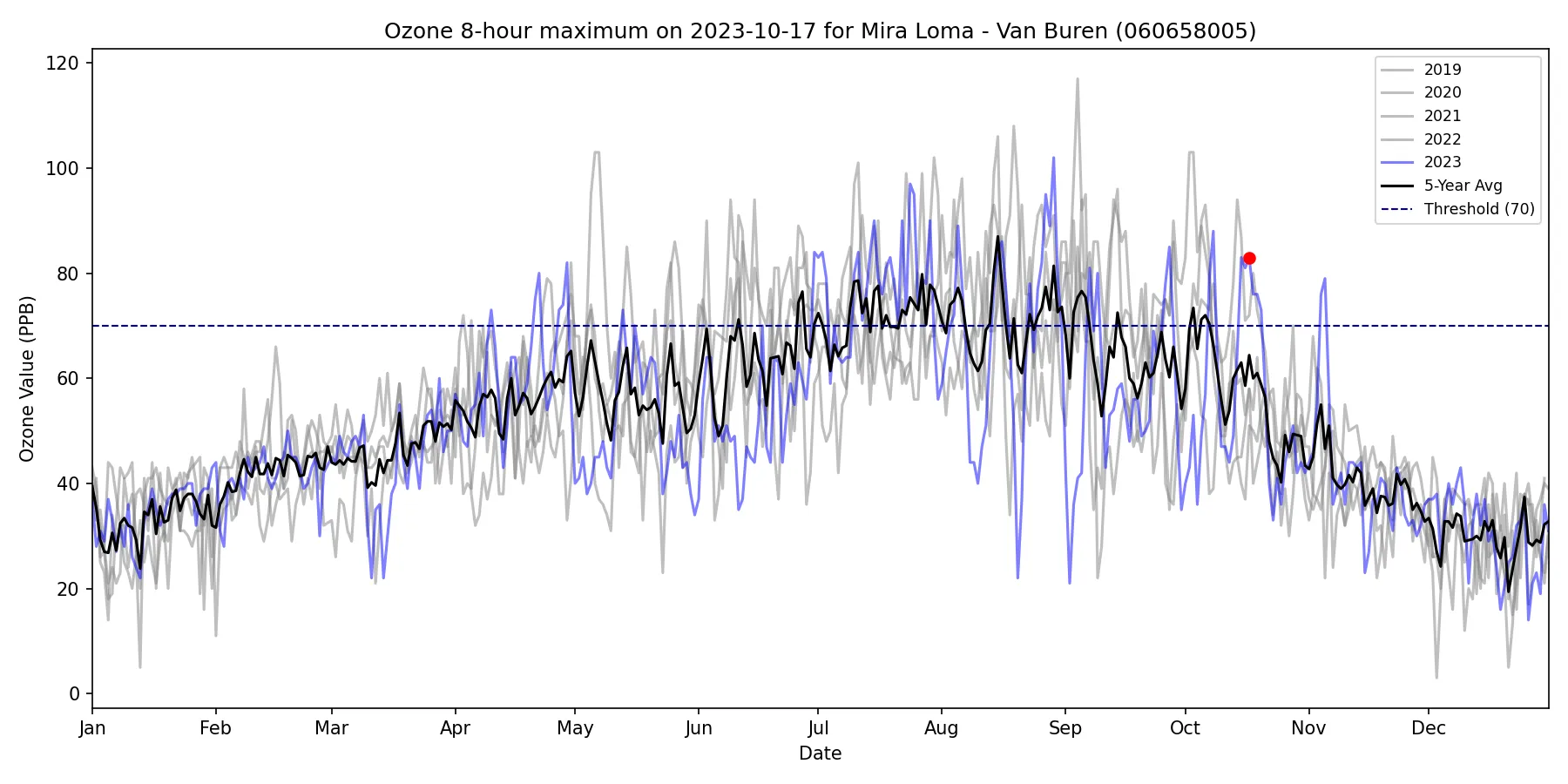
Time series plot of daily maximum 8-Hour ozone concentrations at Mira Loma - Van Buren for each year between 2019 and 2023. The colored dots represent the daily maximum 8-Hour ozone concentrations on Oct. 17, 2023. The black line indicates the 5-year average daily maximum 8-Hour ozone concentration, and the grey dashed line represents the 70 ppb daily ozone standard.
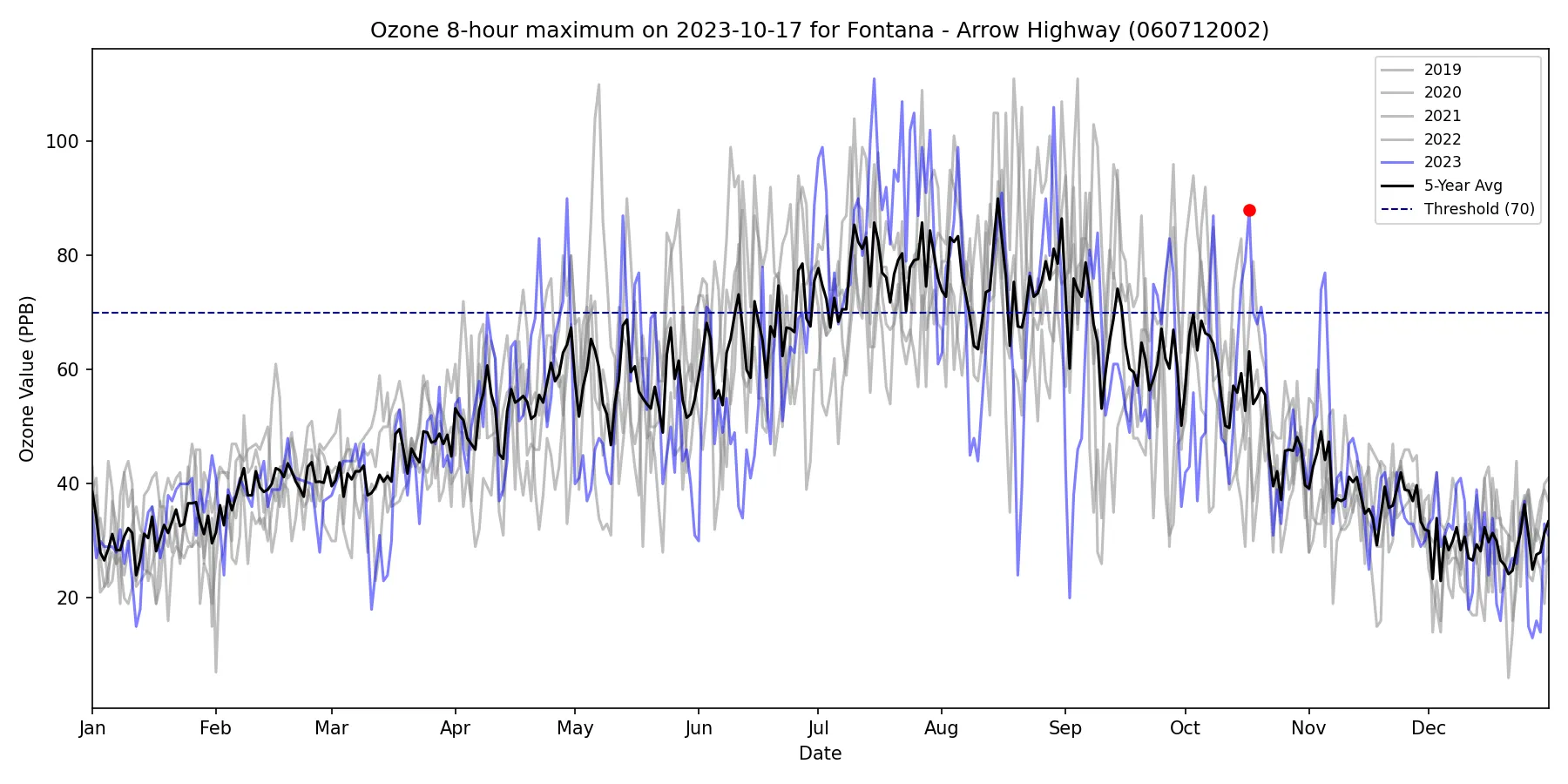
Time series plot of daily maximum 8-Hour ozone concentrations at Fontana - Arrow Highway for each year between 2019 and 2023. The colored dots represent the daily maximum 8-Hour ozone concentrations on Oct. 17, 2023. The black line indicates the 5-year average daily maximum 8-Hour ozone concentration, and the grey dashed line represents the 70 ppb daily ozone standard.
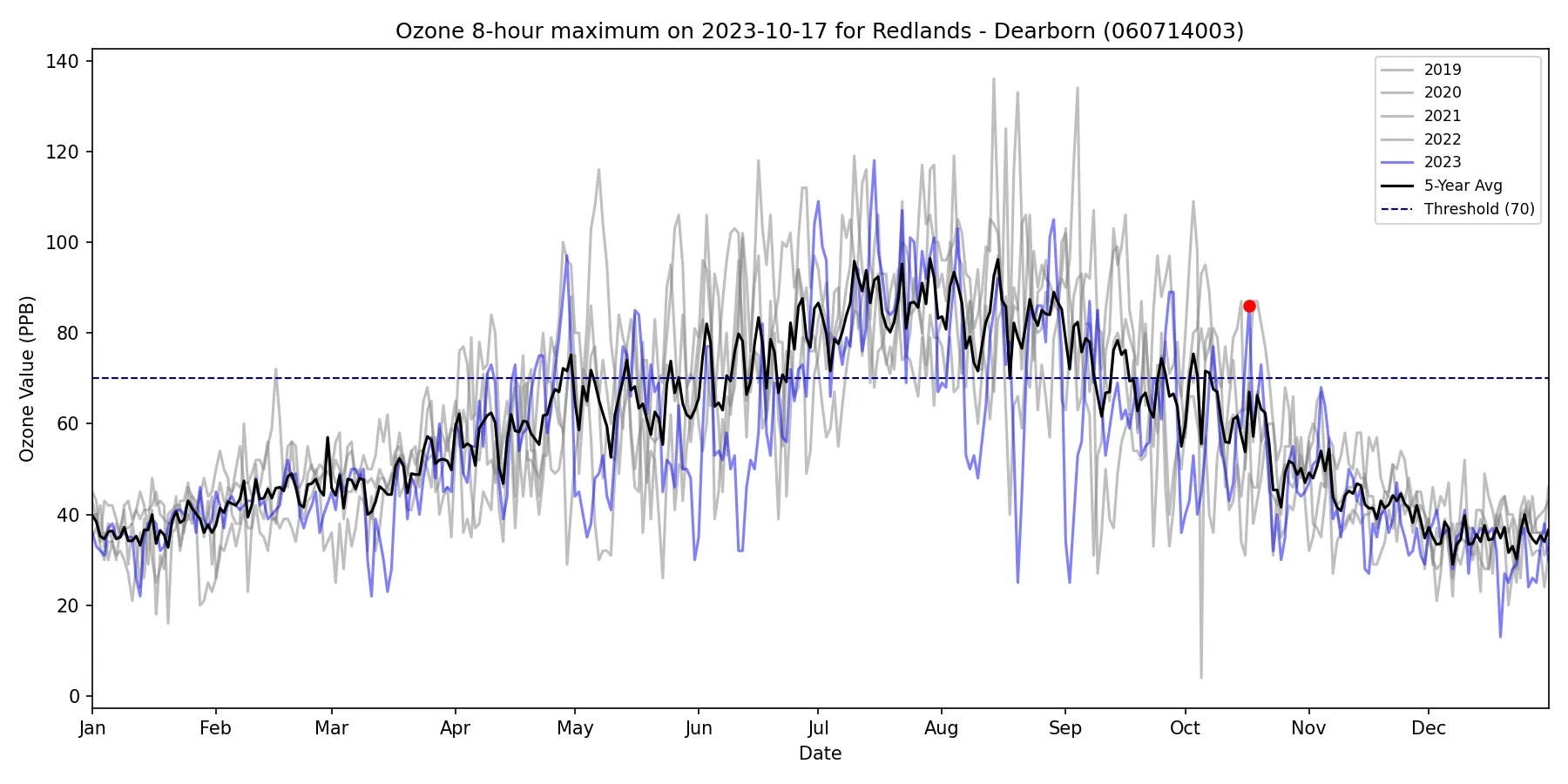
Time series plot of daily maximum 8-Hour ozone concentrations at Redlands - Dearborn for each year between 2019 and 2023. The colored dots represent the daily maximum 8-Hour ozone concentrations on Oct. 17, 2023. The black line indicates the 5-year average daily maximum 8-Hour ozone concentration, and the grey dashed line represents the 70 ppb daily ozone standard.
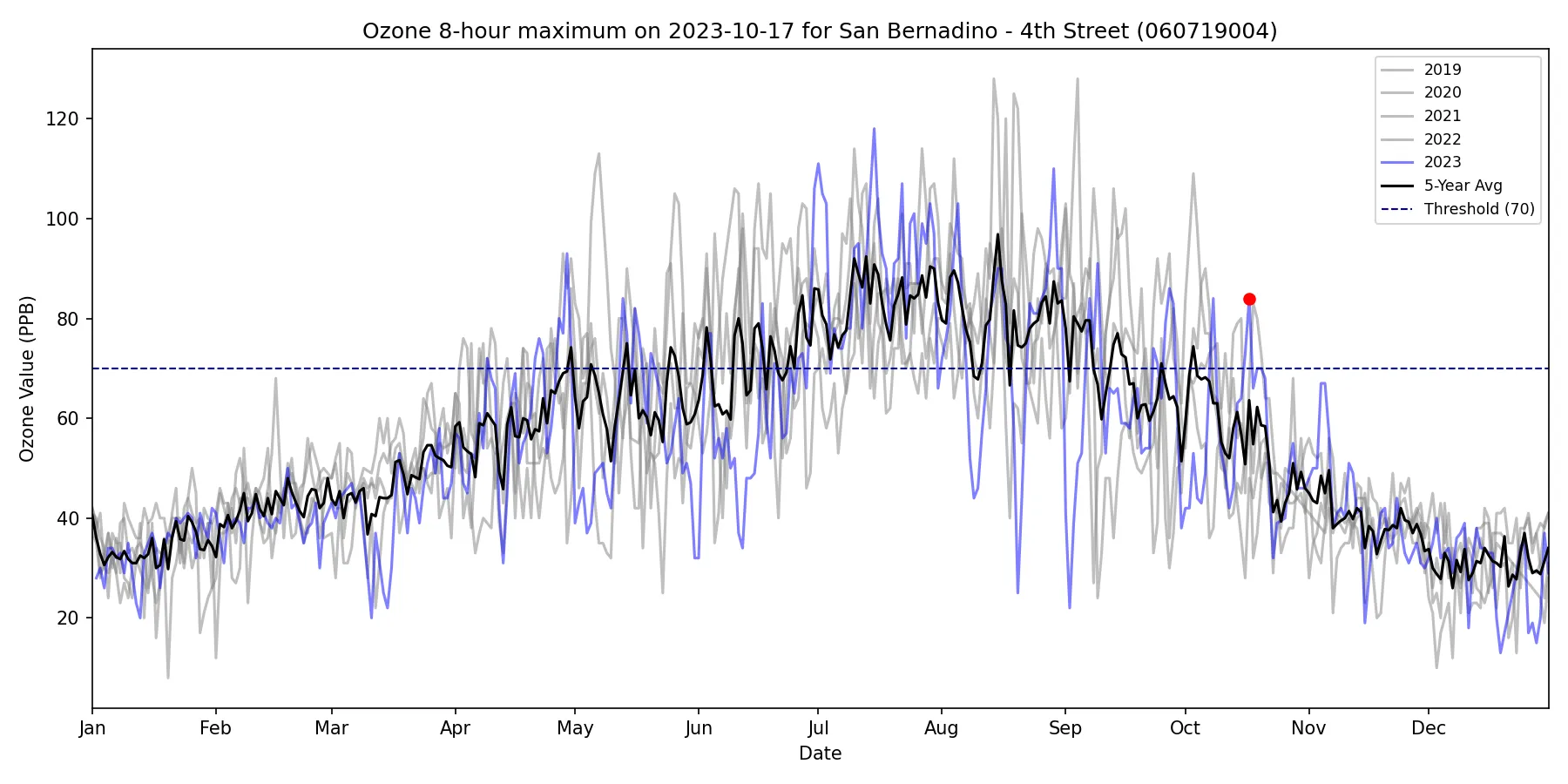
Time series plot of daily maximum 8-Hour ozone concentrations at San Bernadino - 4th Street for each year between 2019 and 2023. The colored dots represent the daily maximum 8-Hour ozone concentrations on Oct. 17, 2023. The black line indicates the 5-year average daily maximum 8-Hour ozone concentration, and the grey dashed line represents the 70 ppb daily ozone standard.
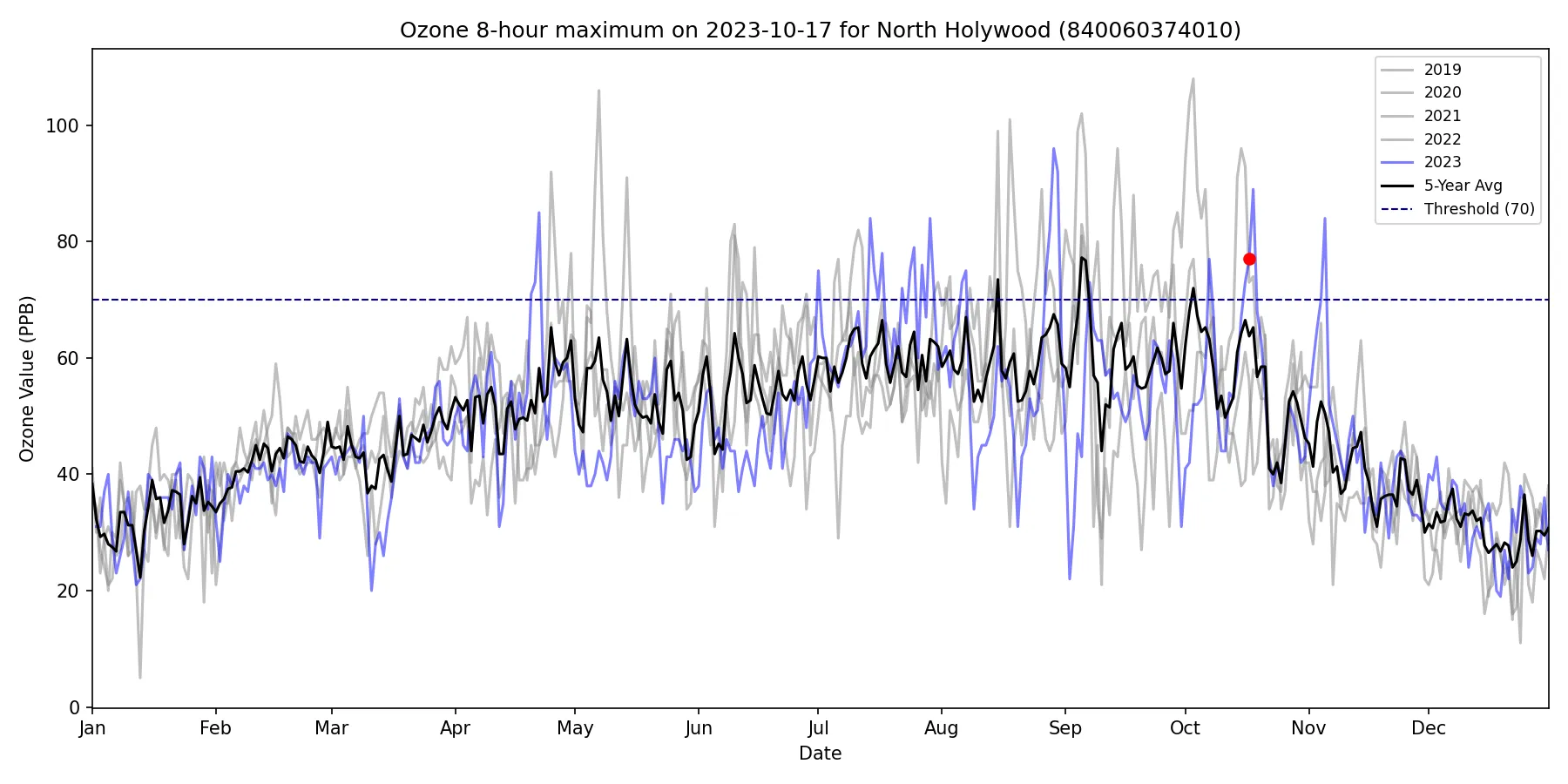
Time series plot of daily maximum 8-Hour ozone concentrations at North Holywood for each year between 2019 and 2023. The colored dots represent the daily maximum 8-Hour ozone concentrations on Oct. 17, 2023. The black line indicates the 5-year average daily maximum 8-Hour ozone concentration, and the grey dashed line represents the 70 ppb daily ozone standard.
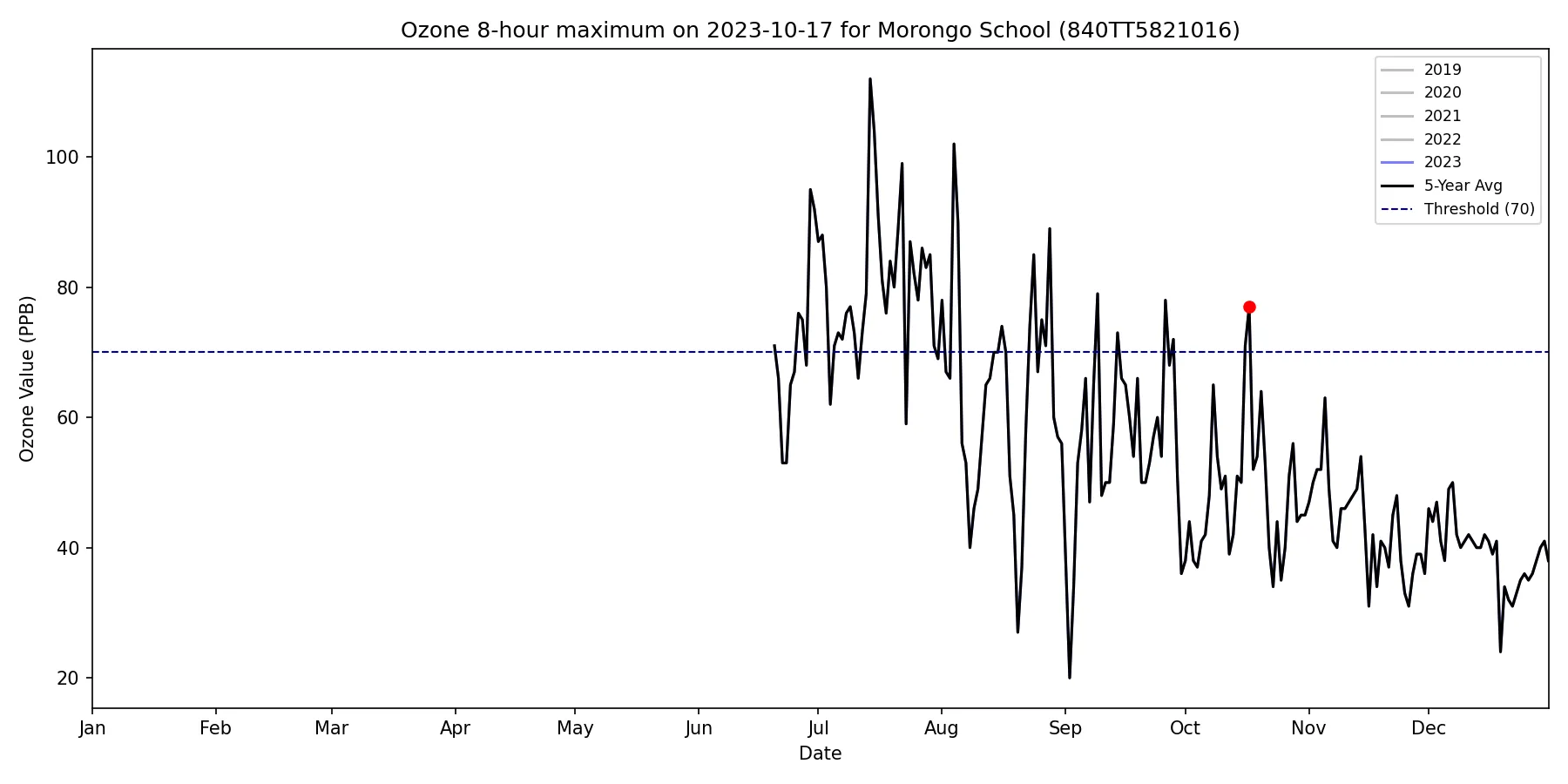
Time series plot of daily maximum 8-Hour ozone concentrations at Morongo School for each year between 2019 and 2023. The colored dots represent the daily maximum 8-Hour ozone concentrations on Oct. 17, 2023. The black line indicates the 5-year average daily maximum 8-Hour ozone concentration, and the grey dashed line represents the 70 ppb daily ozone standard.
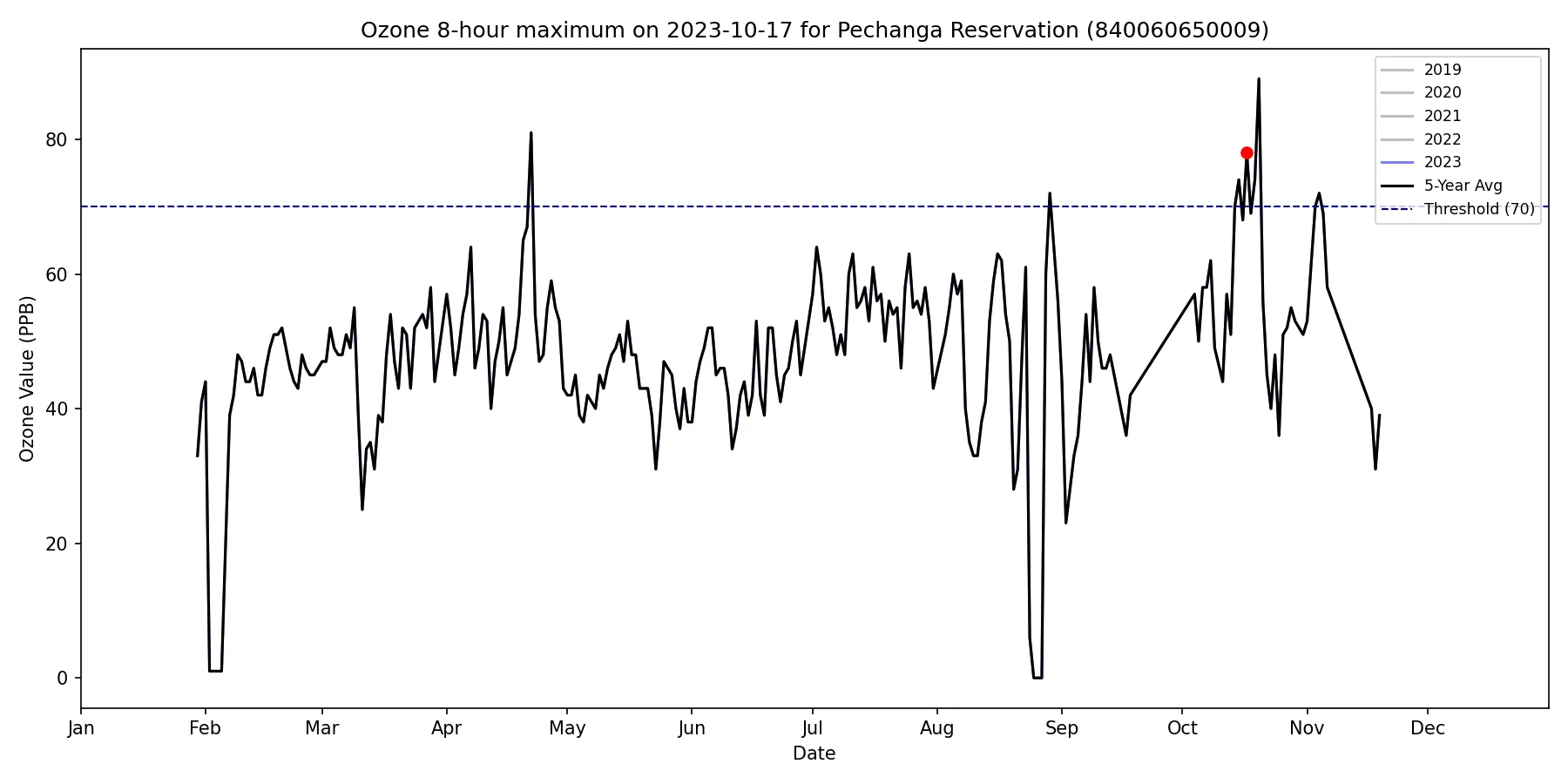
Time series plot of daily maximum 8-Hour ozone concentrations at Pechanga Reservation for each year between 2019 and 2023. The colored dots represent the daily maximum 8-Hour ozone concentrations on Oct. 17, 2023. The black line indicates the 5-year average daily maximum 8-Hour ozone concentration, and the grey dashed line represents the 70 ppb daily ozone standard.
Prescribed Fires within 50 Miles
| Monitor AQS ID | On the Day | One Day Before | Two Days Before |
|---|---|---|---|
| 060659001 |
|
|
|
| 060370016 |
|
|
|
| 060376012 |
|
|
|
| 060658001 |
|
|
|
| 060710005 |
|
|
|
| 060731006 |
|
|
|
| 060371201 |
|
|
|
| 060371701 |
|
|
|
| 060372005 |
|
|
|
| 060650012 |
|
|
|
| 060658005 |
|
|
|
| 060712002 |
|
|
|
| 060714003 |
|
|
|
| 060719004 |
|
|
|
| 840060374010 |
|
|
|
| 840TT5821016 |
|
|
|
| 840060650009 |
|
|
|
Wildfires within 100 Miles
| Monitor AQS ID | 2-Day Range to Exceedance Date |
|---|---|
| 060659001 |
|
| 060370016 |
|
| 060376012 |
|
| 060658001 |
|
| 060710005 |
|
| 060731006 |
|
| 060371201 |
|
| 060371701 |
|
| 060372005 |
|
| 060650012 |
|
| 060658005 |
|
| 060712002 |
|
| 060714003 |
|
| 060719004 |
|
| 840060374010 |
|
| 840TT5821016 |
|
| 840060650009 |
|
Fire Emission Analysis
| Monitor AQS ID | Emission Analysis |
|---|---|
| 060659001 | On October 17, 2023, an analysis was conducted to assess the potential impact of nearby fire activity on ozone levels at Lake Elsinore - W. Flint Street. No wildfires were identified within 100 miles of Lake Elsinore - W. Flint Street. No prescribed fires were identified within 50 miles of Lake Elsinore - W. Flint Street. While no prescribed fires or wildfires were recorded from CAL FIRE and the Prescribed Fire Reporting System (PFIRS), satellite imagery detected 1 fire hotspots over the past two days (from two days before the event to the current day) within 100 miles of the site. This indicates ongoing fire activity in the region, which may have contributed to the observed air quality conditions. However, satellite imagery does not show clear evidence of smoke reaching the monitoring site. This suggests that further analysis is needed to determine whether other factors contributed to the elevated ozone levels. |
| 060370016 | On October 17, 2023, an analysis was conducted to assess the potential impact of nearby fire activity on ozone levels at Glendora - Laurel. No wildfires were identified within 100 miles of Glendora - Laurel. No prescribed fires were identified within 50 miles of Glendora - Laurel. While no prescribed fires or wildfires were recorded from CAL FIRE and the Prescribed Fire Reporting System (PFIRS), satellite imagery detected 1 fire hotspots over the past two days (from two days before the event to the current day) within 100 miles of the site. This indicates ongoing fire activity in the region, which may have contributed to the observed air quality conditions. However, satellite imagery does not show clear evidence of smoke reaching the monitoring site. This suggests that further analysis is needed to determine whether other factors contributed to the elevated ozone levels. |
| 060376012 | No wildfires were identified within 100 miles of Santa Clarita. No prescribed fires were identified within 50 miles of Santa Clarita. While no prescribed fires or wildfires were recorded from CAL FIRE and the Prescribed Fire Reporting System (PFIRS), |
| 060658001 | On October 17, 2023, an analysis was conducted to assess the potential impact of nearby fire activity on ozone levels at Riverside - Rubidoux. No wildfires were identified within 100 miles of Riverside - Rubidoux. No prescribed fires were identified within 50 miles of Riverside - Rubidoux. While no prescribed fires or wildfires were recorded from CAL FIRE and the Prescribed Fire Reporting System (PFIRS), satellite imagery detected 1 fire hotspots over the past two days (from two days before the event to the current day) within 100 miles of the site. This indicates ongoing fire activity in the region, which may have contributed to the observed air quality conditions. However, satellite imagery does not show clear evidence of smoke reaching the monitoring site. This suggests that further analysis is needed to determine whether other factors contributed to the elevated ozone levels. |
| 060710005 | On October 17, 2023, an analysis was conducted to assess the potential impact of nearby fire activity on ozone levels at Crestline - Lake Gregory. No wildfires were identified within 100 miles of Crestline - Lake Gregory. No prescribed fires were identified within 50 miles of Crestline - Lake Gregory. While no prescribed fires or wildfires were recorded from CAL FIRE and the Prescribed Fire Reporting System (PFIRS), satellite imagery detected 1 fire hotspots over the past two days (from two days before the event to the current day) within 100 miles of the site. This indicates ongoing fire activity in the region, which may have contributed to the observed air quality conditions. However, satellite imagery does not show clear evidence of smoke reaching the monitoring site. This suggests that further analysis is needed to determine whether other factors contributed to the elevated ozone levels. |
| 060731006 | On October 17, 2023, an analysis was conducted to assess the potential impact of nearby fire activity on ozone levels at Alpine. No wildfires were identified within 100 miles of Alpine. No prescribed fires were identified within 50 miles of Alpine. While no prescribed fires or wildfires were recorded from CAL FIRE and the Prescribed Fire Reporting System (PFIRS), satellite imagery detected 17 fire hotspots over the past two days (from two days before the event to the current day) within 100 miles of the site. This indicates ongoing fire activity in the region, which may have contributed to the observed air quality conditions. However, satellite imagery does not show clear evidence of smoke reaching the monitoring site. This suggests that further analysis is needed to determine whether other factors contributed to the elevated ozone levels. |
| 060371201 | No wildfires were identified within 100 miles of Reseda. No prescribed fires were identified within 50 miles of Reseda. While no prescribed fires or wildfires were recorded from CAL FIRE and the Prescribed Fire Reporting System (PFIRS), |
| 060371701 | On October 17, 2023, an analysis was conducted to assess the potential impact of nearby fire activity on ozone levels at Pomona. No wildfires were identified within 100 miles of Pomona. No prescribed fires were identified within 50 miles of Pomona. While no prescribed fires or wildfires were recorded from CAL FIRE and the Prescribed Fire Reporting System (PFIRS), satellite imagery detected 1 fire hotspots over the past two days (from two days before the event to the current day) within 100 miles of the site. This indicates ongoing fire activity in the region, which may have contributed to the observed air quality conditions. However, satellite imagery does not show clear evidence of smoke reaching the monitoring site. This suggests that further analysis is needed to determine whether other factors contributed to the elevated ozone levels. |
| 060372005 | On October 17, 2023, an analysis was conducted to assess the potential impact of nearby fire activity on ozone levels at Pasadena. No wildfires were identified within 100 miles of Pasadena. No prescribed fires were identified within 50 miles of Pasadena. While no prescribed fires or wildfires were recorded from CAL FIRE and the Prescribed Fire Reporting System (PFIRS), satellite imagery detected 1 fire hotspots over the past two days (from two days before the event to the current day) within 100 miles of the site. This indicates ongoing fire activity in the region, which may have contributed to the observed air quality conditions. However, satellite imagery does not show clear evidence of smoke reaching the monitoring site. This suggests that further analysis is needed to determine whether other factors contributed to the elevated ozone levels. |
| 060650012 | On October 17, 2023, an analysis was conducted to assess the potential impact of nearby fire activity on ozone levels at Banning - South Hathaway Street. No wildfires were identified within 100 miles of Banning - South Hathaway Street. No prescribed fires were identified within 50 miles of Banning - South Hathaway Street. While no prescribed fires or wildfires were recorded from CAL FIRE and the Prescribed Fire Reporting System (PFIRS), satellite imagery detected 11 fire hotspots over the past two days (from two days before the event to the current day) within 100 miles of the site. This indicates ongoing fire activity in the region, which may have contributed to the observed air quality conditions. However, satellite imagery does not show clear evidence of smoke reaching the monitoring site. This suggests that further analysis is needed to determine whether other factors contributed to the elevated ozone levels. |
| 060658005 | On October 17, 2023, an analysis was conducted to assess the potential impact of nearby fire activity on ozone levels at Mira Loma - Van Buren. No wildfires were identified within 100 miles of Mira Loma - Van Buren. No prescribed fires were identified within 50 miles of Mira Loma - Van Buren. While no prescribed fires or wildfires were recorded from CAL FIRE and the Prescribed Fire Reporting System (PFIRS), satellite imagery detected 1 fire hotspots over the past two days (from two days before the event to the current day) within 100 miles of the site. This indicates ongoing fire activity in the region, which may have contributed to the observed air quality conditions. However, satellite imagery does not show clear evidence of smoke reaching the monitoring site. This suggests that further analysis is needed to determine whether other factors contributed to the elevated ozone levels. |
| 060712002 | On October 17, 2023, an analysis was conducted to assess the potential impact of nearby fire activity on ozone levels at Fontana - Arrow Highway. No wildfires were identified within 100 miles of Fontana - Arrow Highway. No prescribed fires were identified within 50 miles of Fontana - Arrow Highway. While no prescribed fires or wildfires were recorded from CAL FIRE and the Prescribed Fire Reporting System (PFIRS), satellite imagery detected 1 fire hotspots over the past two days (from two days before the event to the current day) within 100 miles of the site. This indicates ongoing fire activity in the region, which may have contributed to the observed air quality conditions. However, satellite imagery does not show clear evidence of smoke reaching the monitoring site. This suggests that further analysis is needed to determine whether other factors contributed to the elevated ozone levels. |
| 060714003 | On October 17, 2023, an analysis was conducted to assess the potential impact of nearby fire activity on ozone levels at Redlands - Dearborn. No wildfires were identified within 100 miles of Redlands - Dearborn. No prescribed fires were identified within 50 miles of Redlands - Dearborn. While no prescribed fires or wildfires were recorded from CAL FIRE and the Prescribed Fire Reporting System (PFIRS), satellite imagery detected 1 fire hotspots over the past two days (from two days before the event to the current day) within 100 miles of the site. This indicates ongoing fire activity in the region, which may have contributed to the observed air quality conditions. However, satellite imagery does not show clear evidence of smoke reaching the monitoring site. This suggests that further analysis is needed to determine whether other factors contributed to the elevated ozone levels. |
| 060719004 | On October 17, 2023, an analysis was conducted to assess the potential impact of nearby fire activity on ozone levels at San Bernadino - 4th Street. No wildfires were identified within 100 miles of San Bernadino - 4th Street. No prescribed fires were identified within 50 miles of San Bernadino - 4th Street. While no prescribed fires or wildfires were recorded from CAL FIRE and the Prescribed Fire Reporting System (PFIRS), satellite imagery detected 1 fire hotspots over the past two days (from two days before the event to the current day) within 100 miles of the site. This indicates ongoing fire activity in the region, which may have contributed to the observed air quality conditions. However, satellite imagery does not show clear evidence of smoke reaching the monitoring site. This suggests that further analysis is needed to determine whether other factors contributed to the elevated ozone levels. |
| 840060374010 | On October 17, 2023, an analysis was conducted to assess the potential impact of nearby fire activity on ozone levels at North Holywood. No wildfires were identified within 100 miles of North Holywood. No prescribed fires were identified within 50 miles of North Holywood. While no prescribed fires or wildfires were recorded from CAL FIRE and the Prescribed Fire Reporting System (PFIRS), satellite imagery detected 1 fire hotspots over the past two days (from two days before the event to the current day) within 100 miles of the site. This indicates ongoing fire activity in the region, which may have contributed to the observed air quality conditions. However, satellite imagery does not show clear evidence of smoke reaching the monitoring site. This suggests that further analysis is needed to determine whether other factors contributed to the elevated ozone levels. |
| 840TT5821016 | On October 17, 2023, an analysis was conducted to assess the potential impact of nearby fire activity on ozone levels at Morongo School. No wildfires were identified within 100 miles of Morongo School. No prescribed fires were identified within 50 miles of Morongo School. While no prescribed fires or wildfires were recorded from CAL FIRE and the Prescribed Fire Reporting System (PFIRS), satellite imagery detected 12 fire hotspots over the past two days (from two days before the event to the current day) within 100 miles of the site. This indicates ongoing fire activity in the region, which may have contributed to the observed air quality conditions. However, satellite imagery does not show clear evidence of smoke reaching the monitoring site. This suggests that further analysis is needed to determine whether other factors contributed to the elevated ozone levels. |
| 840060650009 | On October 17, 2023, an analysis was conducted to assess the potential impact of nearby fire activity on ozone levels at Pechanga Reservation. No wildfires were identified within 100 miles of Pechanga Reservation. No prescribed fires were identified within 50 miles of Pechanga Reservation. While no prescribed fires or wildfires were recorded from CAL FIRE and the Prescribed Fire Reporting System (PFIRS), satellite imagery detected 11 fire hotspots over the past two days (from two days before the event to the current day) within 100 miles of the site. This indicates ongoing fire activity in the region, which may have contributed to the observed air quality conditions. However, satellite imagery does not show clear evidence of smoke reaching the monitoring site. This suggests that further analysis is needed to determine whether other factors contributed to the elevated ozone levels. |
High-Split Trajectory for Ozone Exceedance Monitor Site
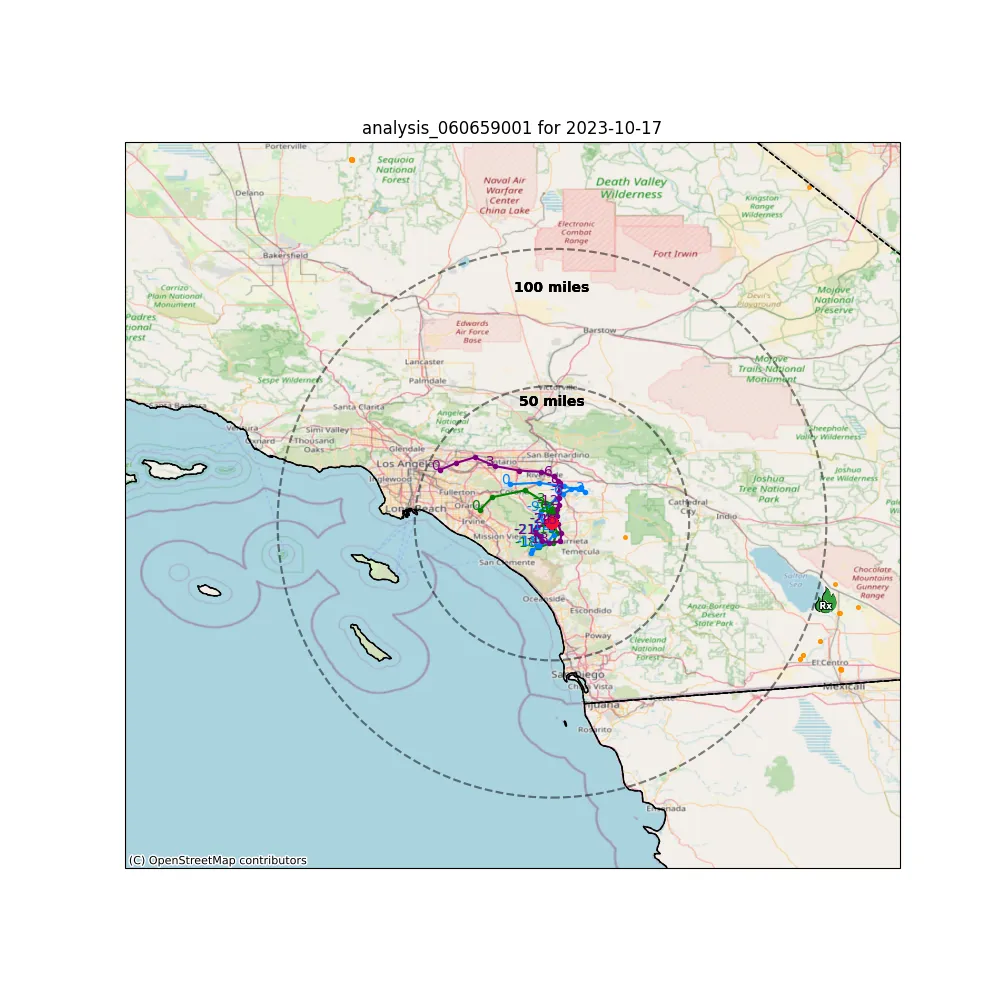
HYSPLIT 24-hour Backward Trajectories from the Lake Elsinore - W. Flint Street site (060659001) at 100, 150, and 200 meters above ground level, initiated at the highest hourly concentration on Oct. 17, 2023.
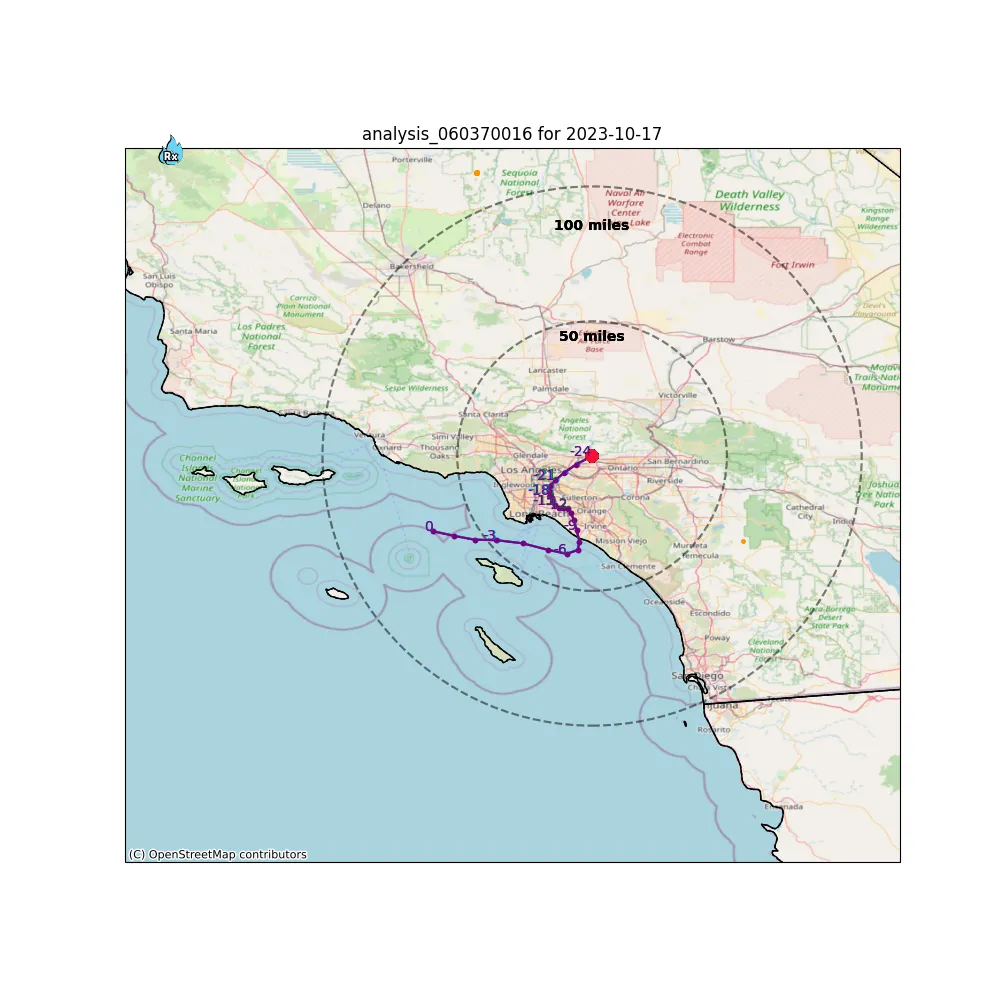
HYSPLIT 24-hour Backward Trajectories from the Glendora - Laurel site (060370016) at 100, 150, and 200 meters above ground level, initiated at the highest hourly concentration on Oct. 17, 2023.
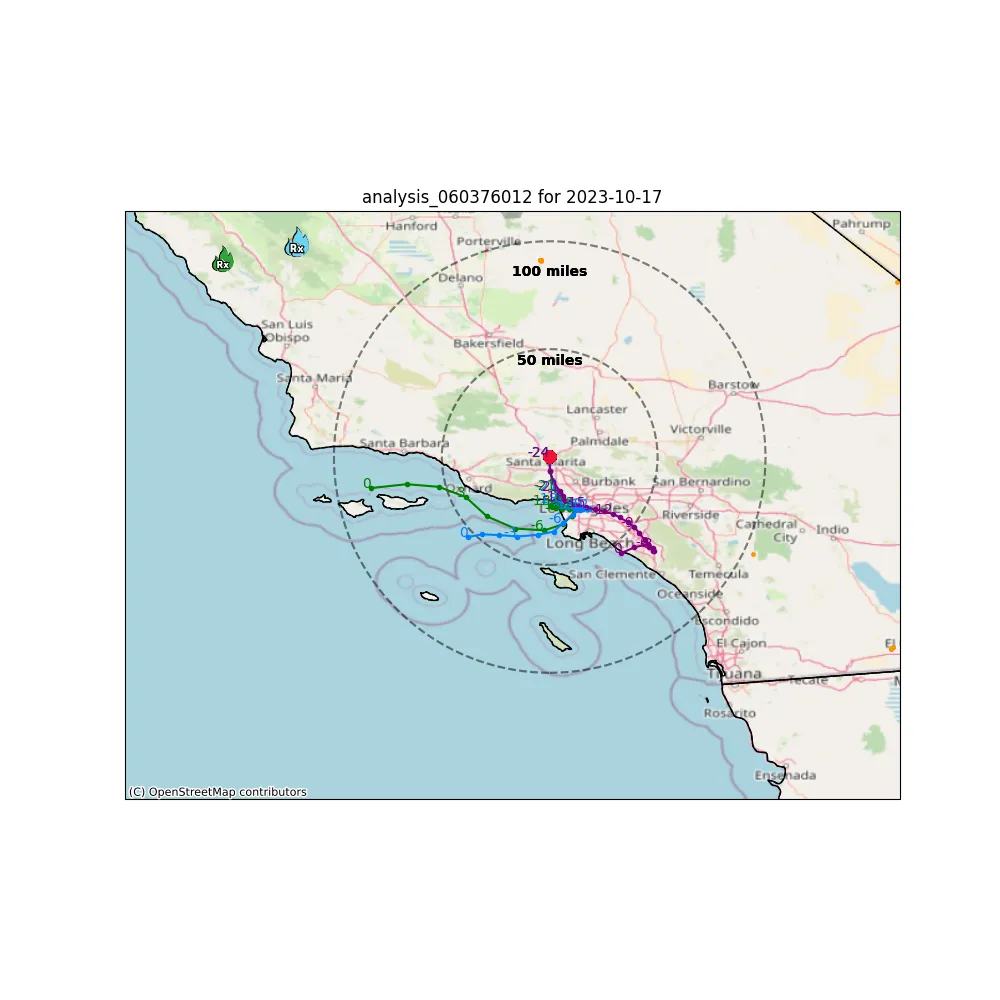
HYSPLIT 24-hour Backward Trajectories from the Santa Clarita site (060376012) at 100, 150, and 200 meters above ground level, initiated at the highest hourly concentration on Oct. 17, 2023.
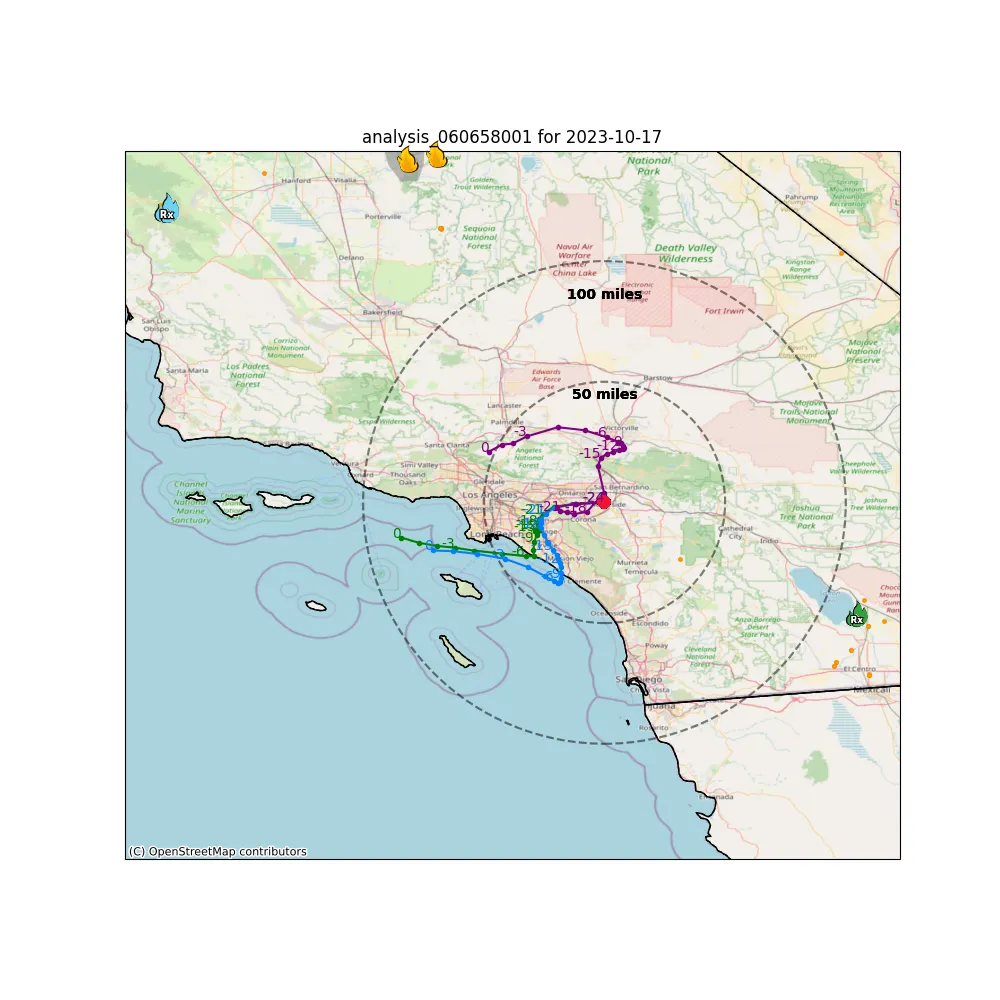
HYSPLIT 24-hour Backward Trajectories from the Riverside - Rubidoux site (060658001) at 100, 150, and 200 meters above ground level, initiated at the highest hourly concentration on Oct. 17, 2023.
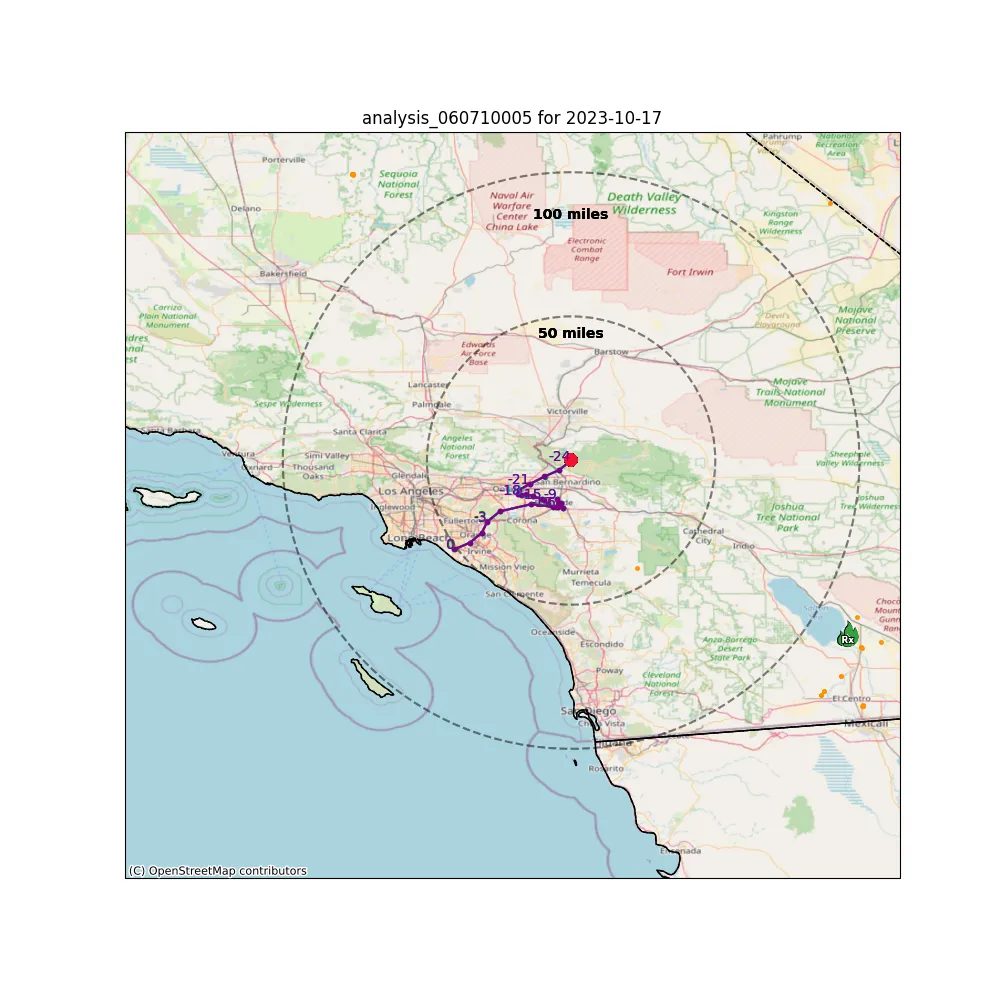
HYSPLIT 24-hour Backward Trajectories from the Crestline - Lake Gregory site (060710005) at 100, 150, and 200 meters above ground level, initiated at the highest hourly concentration on Oct. 17, 2023.
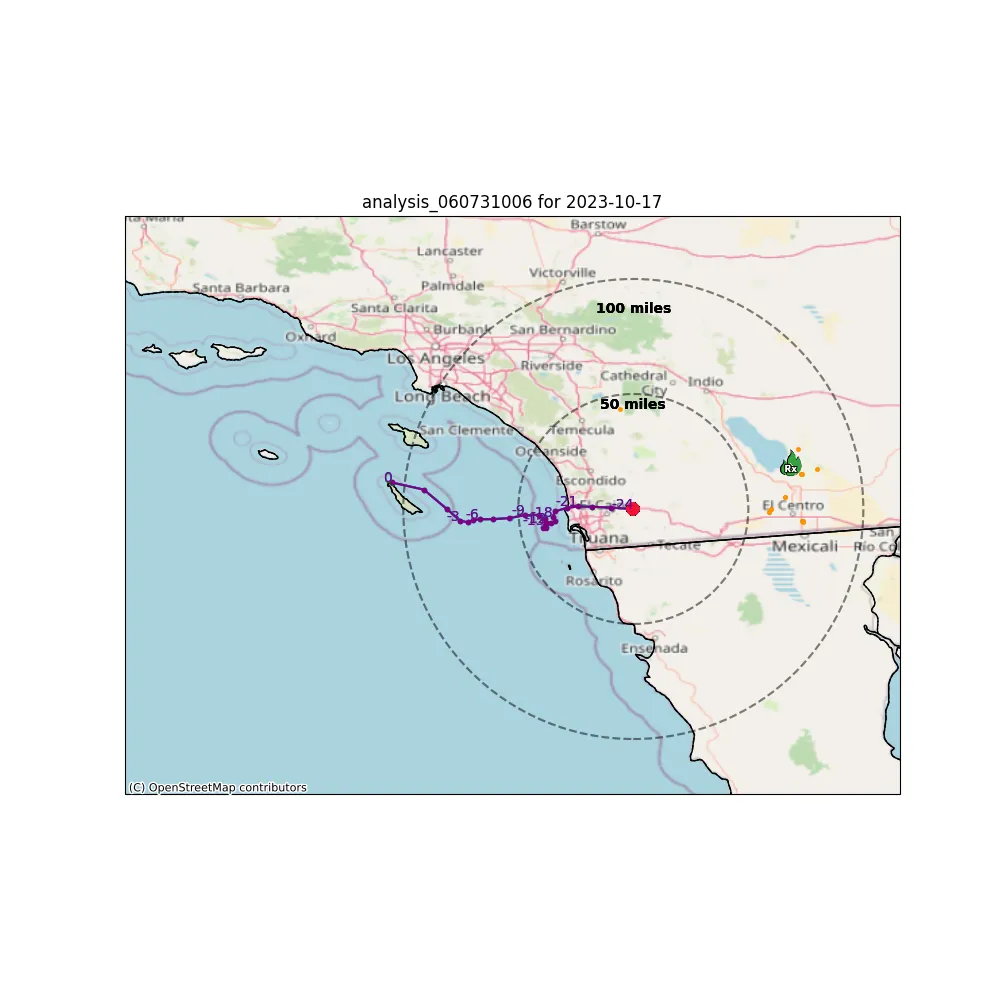
HYSPLIT 24-hour Backward Trajectories from the Alpine site (060731006) at 100, 150, and 200 meters above ground level, initiated at the highest hourly concentration on Oct. 17, 2023.
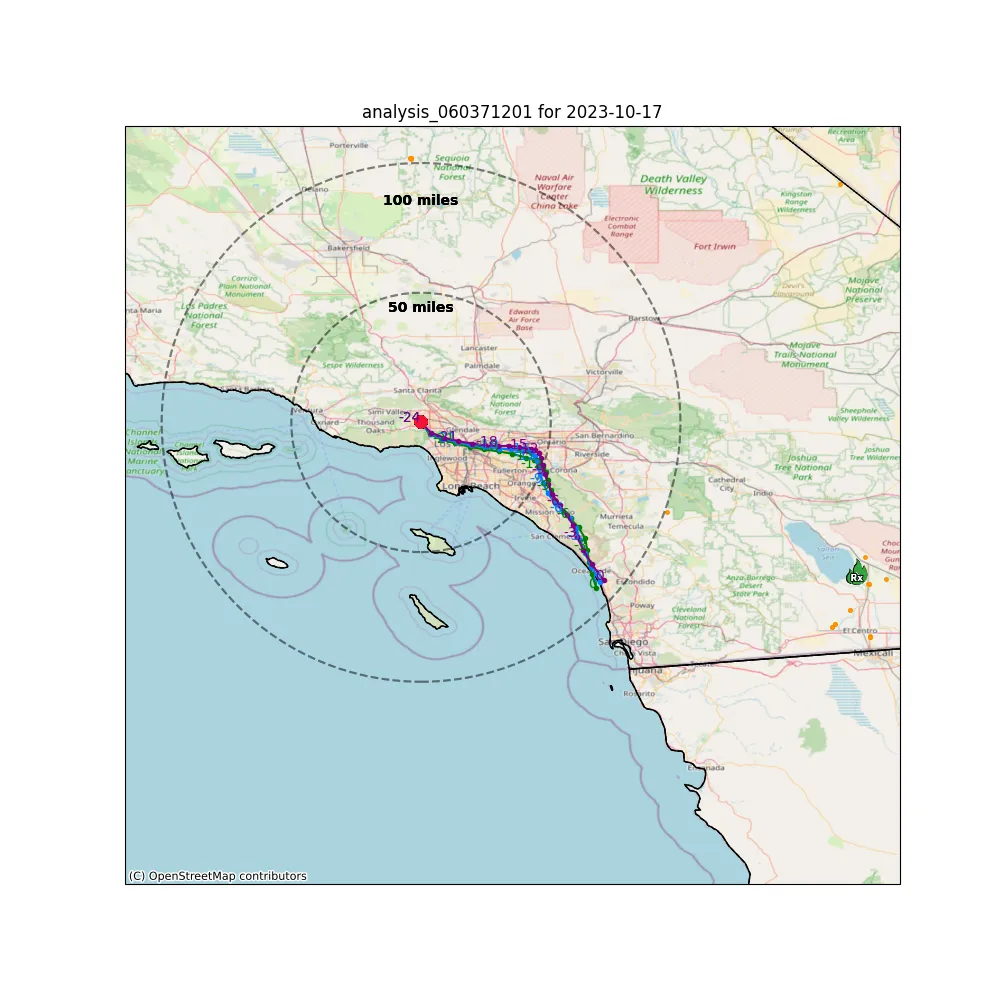
HYSPLIT 24-hour Backward Trajectories from the Reseda site (060371201) at 100, 150, and 200 meters above ground level, initiated at the highest hourly concentration on Oct. 17, 2023.
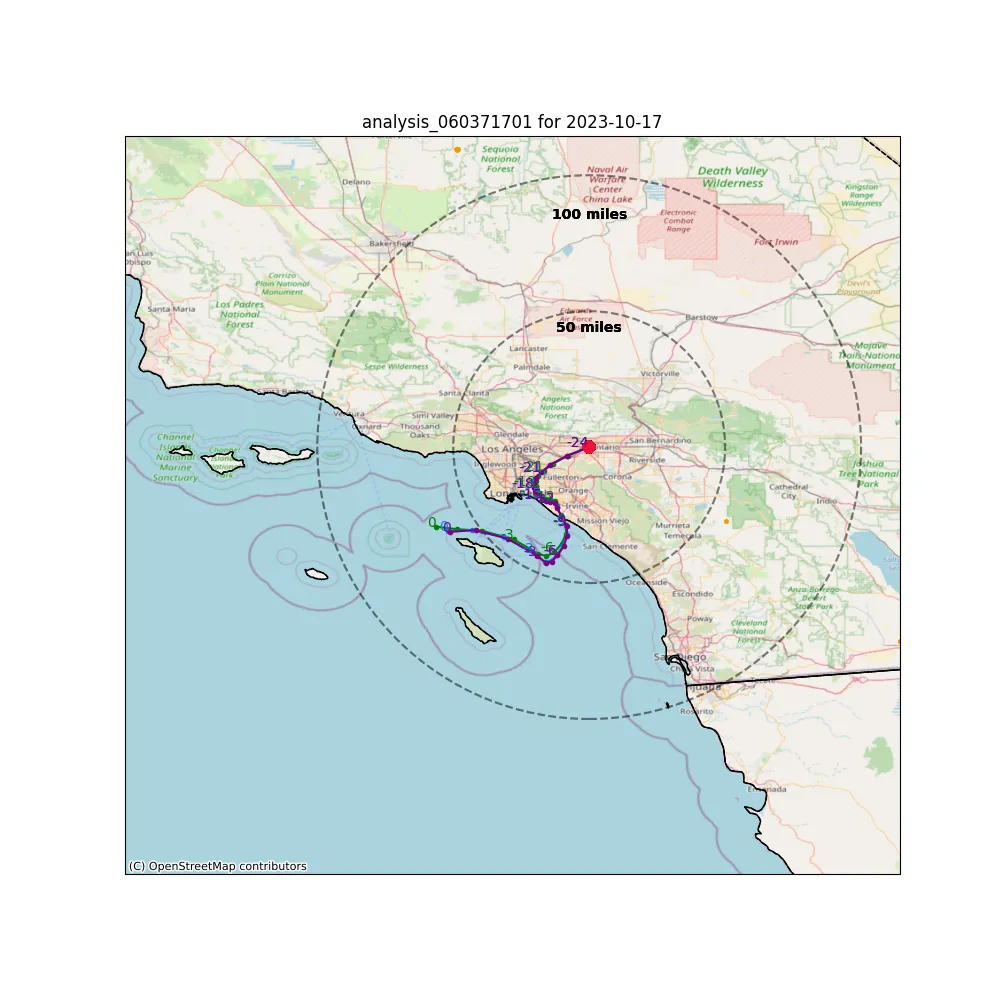
HYSPLIT 24-hour Backward Trajectories from the Pomona site (060371701) at 100, 150, and 200 meters above ground level, initiated at the highest hourly concentration on Oct. 17, 2023.
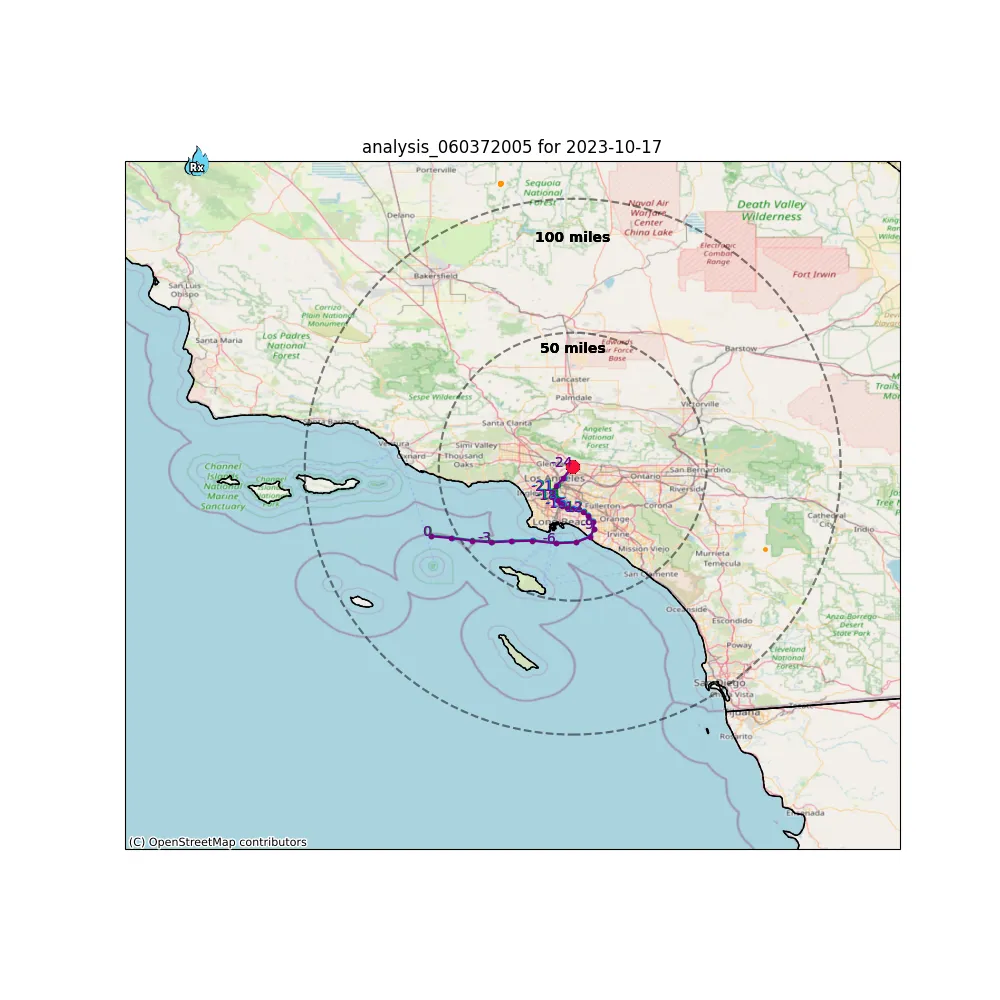
HYSPLIT 24-hour Backward Trajectories from the Pasadena site (060372005) at 100, 150, and 200 meters above ground level, initiated at the highest hourly concentration on Oct. 17, 2023.
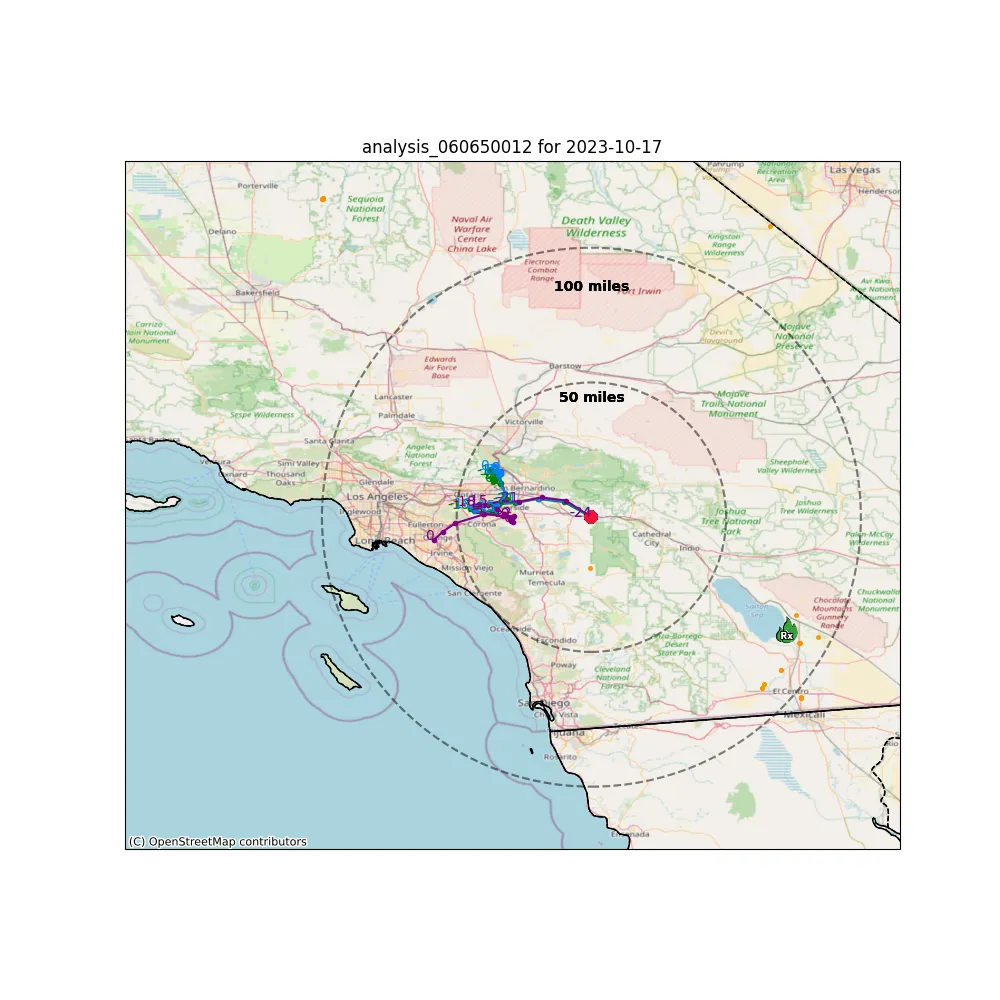
HYSPLIT 24-hour Backward Trajectories from the Banning - South Hathaway Street site (060650012) at 100, 150, and 200 meters above ground level, initiated at the highest hourly concentration on Oct. 17, 2023.
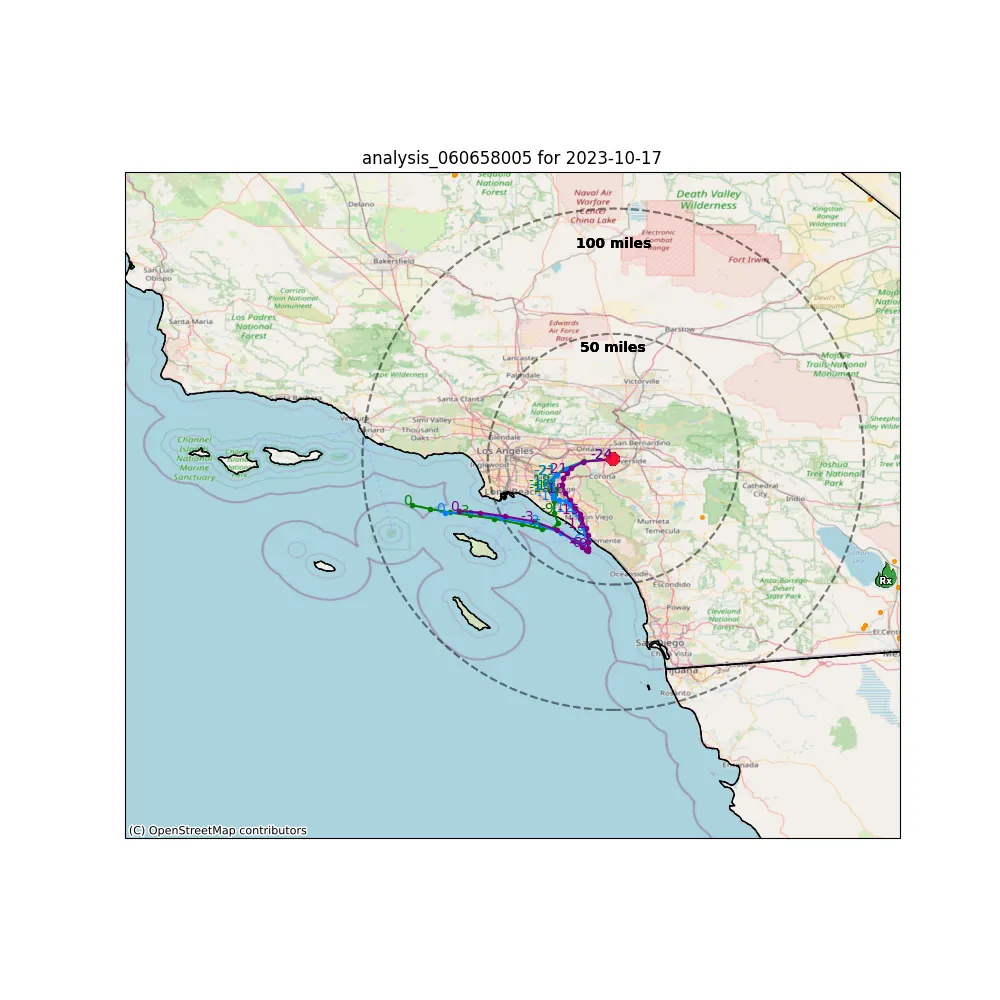
HYSPLIT 24-hour Backward Trajectories from the Mira Loma - Van Buren site (060658005) at 100, 150, and 200 meters above ground level, initiated at the highest hourly concentration on Oct. 17, 2023.
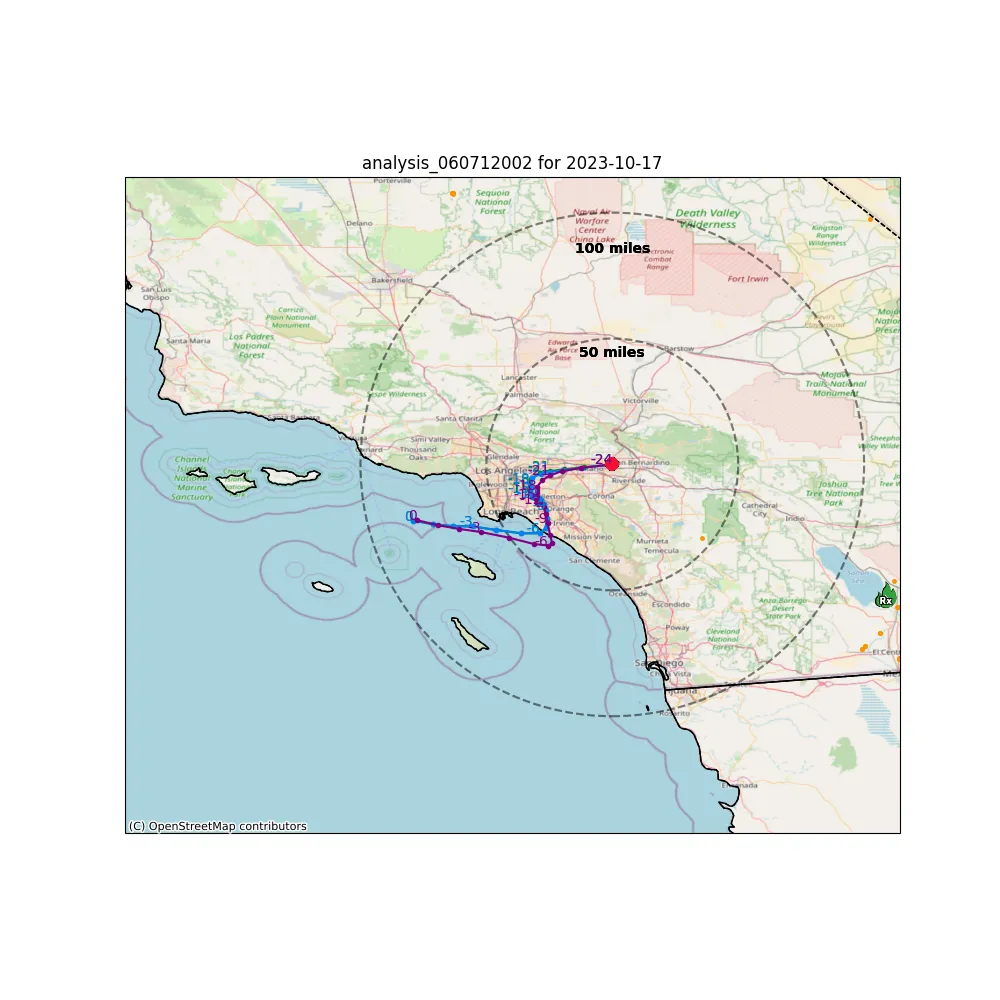
HYSPLIT 24-hour Backward Trajectories from the Fontana - Arrow Highway site (060712002) at 100, 150, and 200 meters above ground level, initiated at the highest hourly concentration on Oct. 17, 2023.
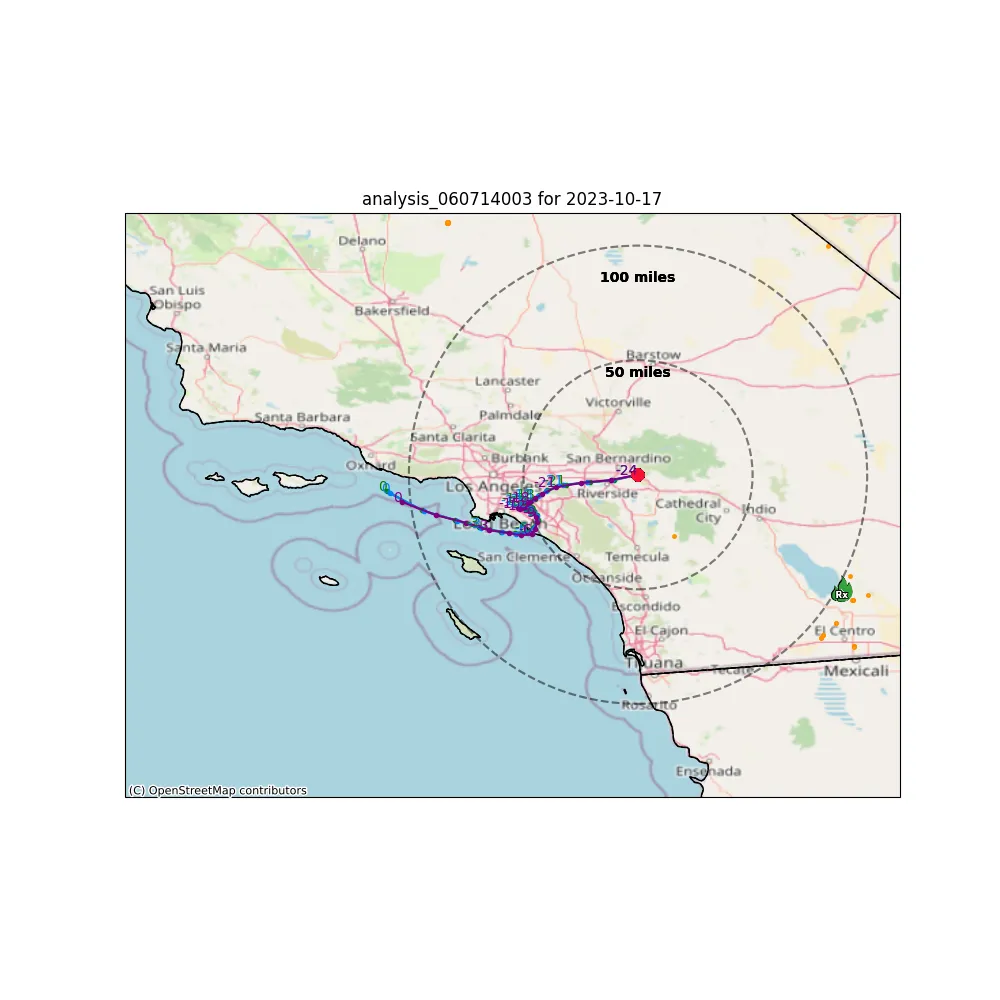
HYSPLIT 24-hour Backward Trajectories from the Redlands - Dearborn site (060714003) at 100, 150, and 200 meters above ground level, initiated at the highest hourly concentration on Oct. 17, 2023.
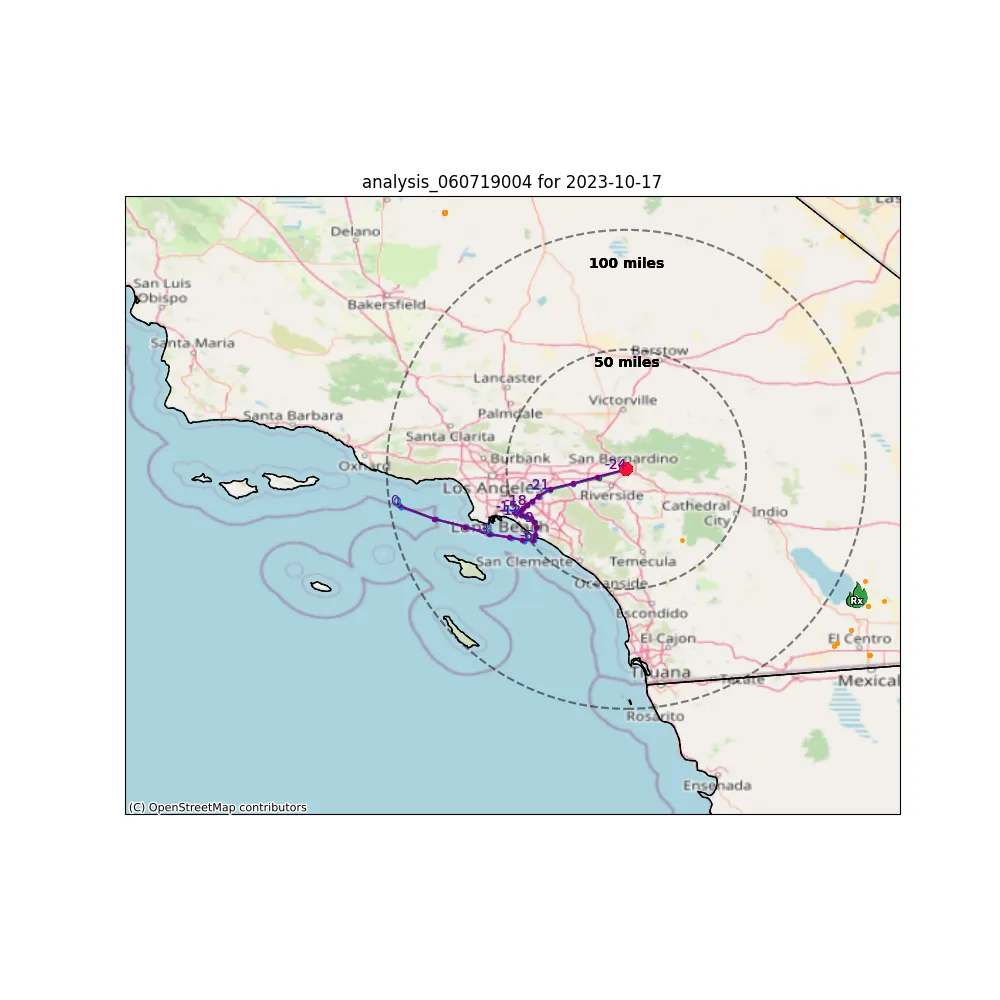
HYSPLIT 24-hour Backward Trajectories from the San Bernadino - 4th Street site (060719004) at 100, 150, and 200 meters above ground level, initiated at the highest hourly concentration on Oct. 17, 2023.
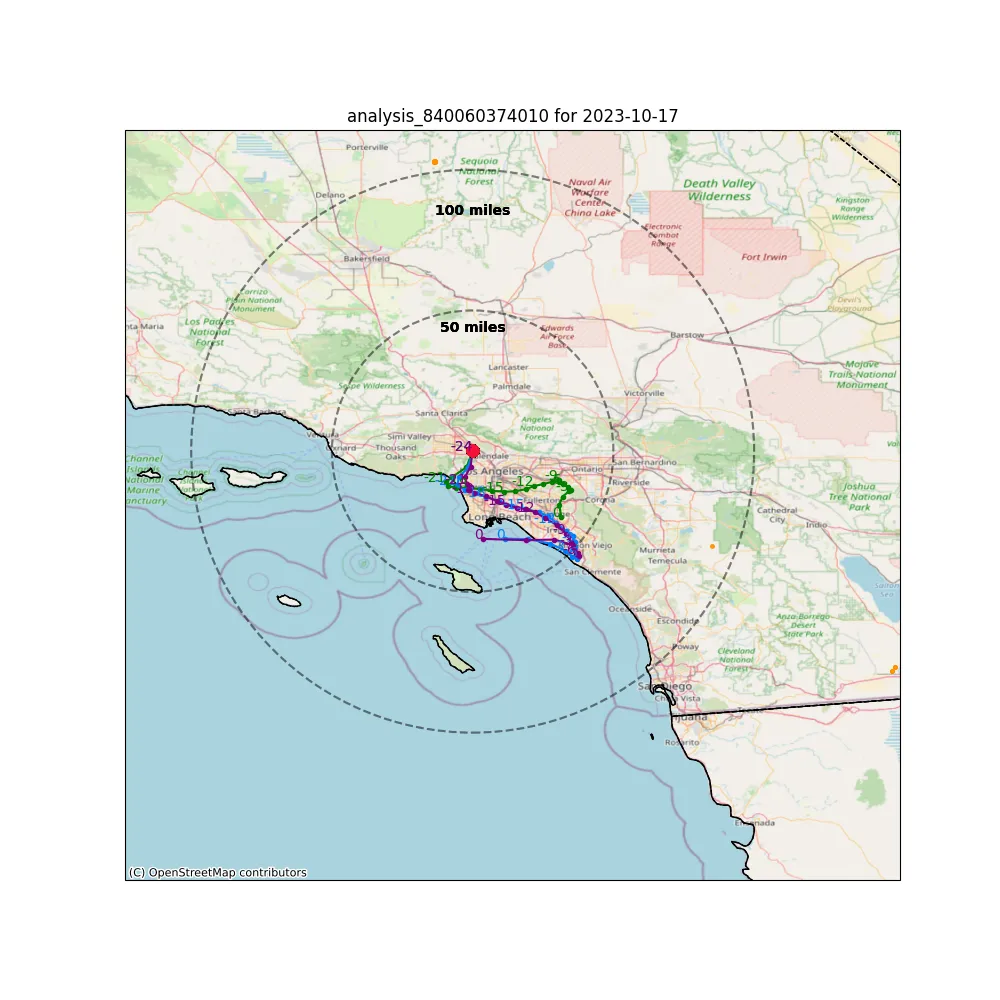
HYSPLIT 24-hour Backward Trajectories from the North Holywood site (840060374010) at 100, 150, and 200 meters above ground level, initiated at the highest hourly concentration on Oct. 17, 2023.
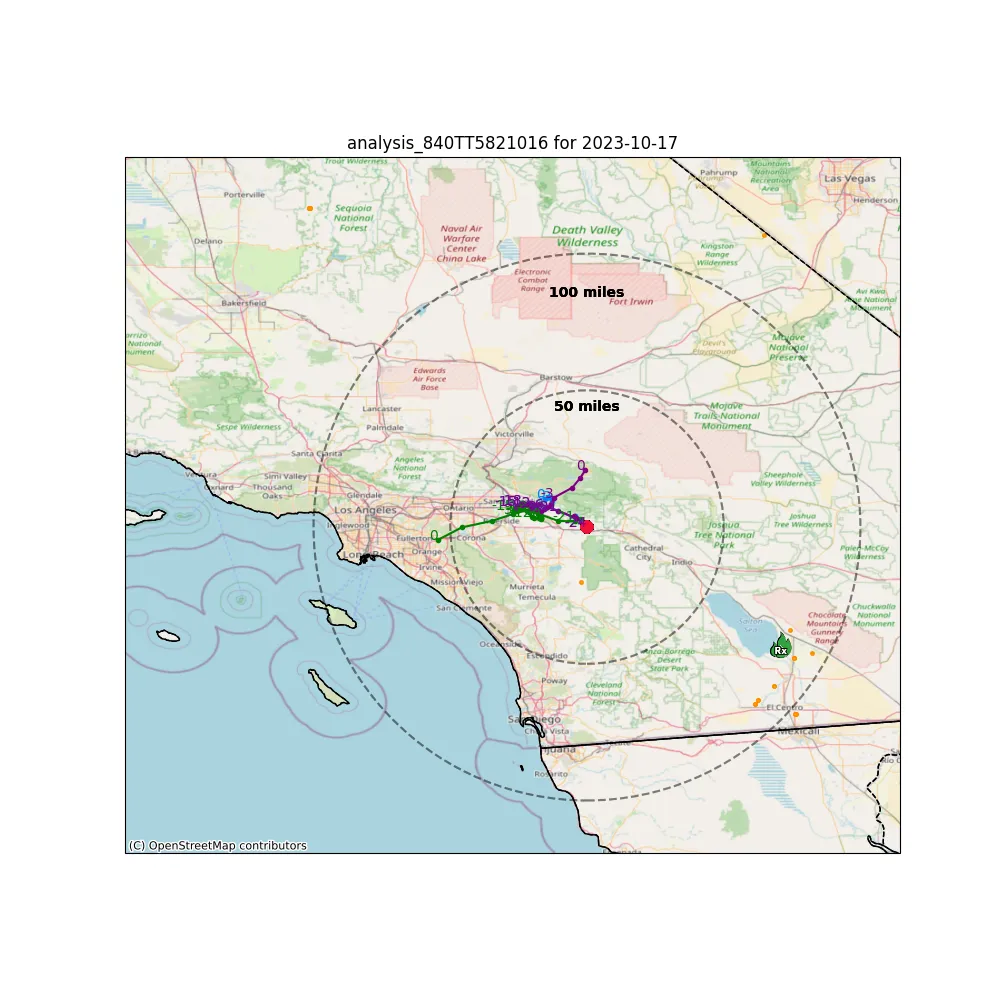
HYSPLIT 24-hour Backward Trajectories from the Morongo School site (840TT5821016) at 100, 150, and 200 meters above ground level, initiated at the highest hourly concentration on Oct. 17, 2023.
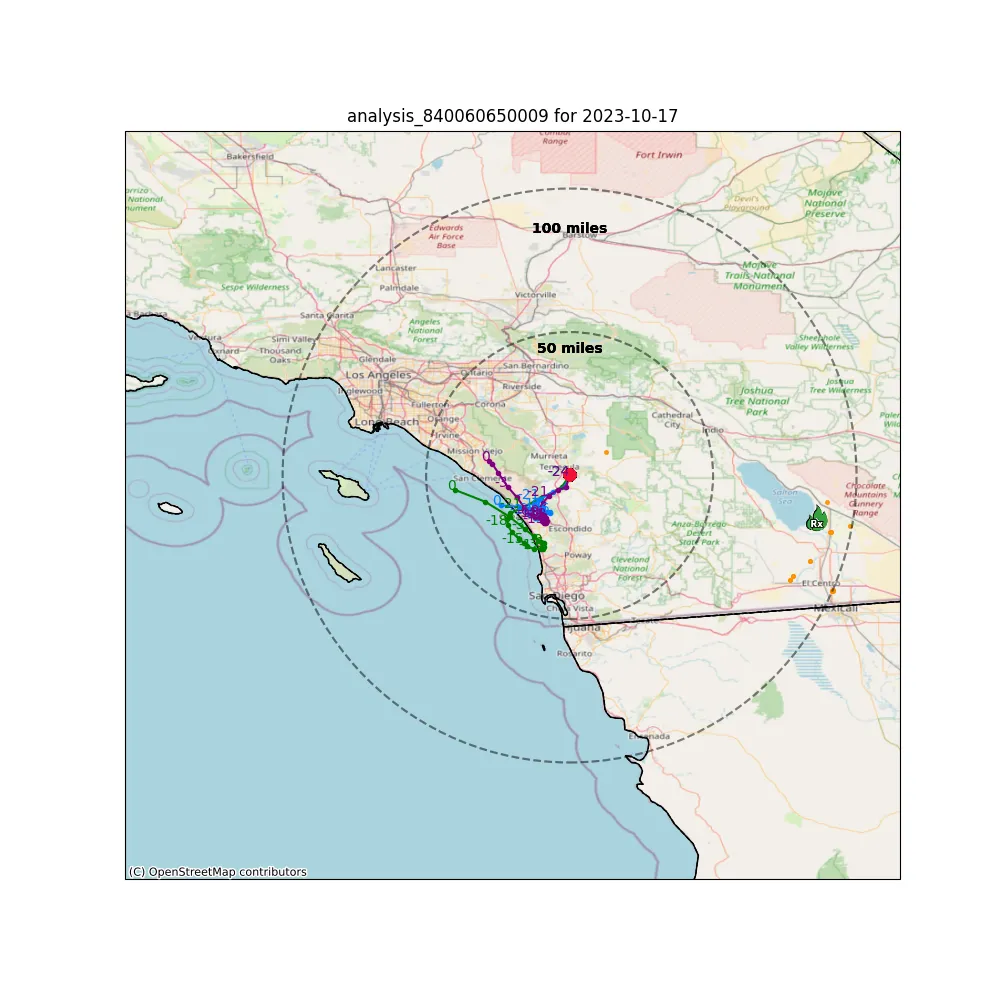
HYSPLIT 24-hour Backward Trajectories from the Pechanga Reservation site (840060650009) at 100, 150, and 200 meters above ground level, initiated at the highest hourly concentration on Oct. 17, 2023.